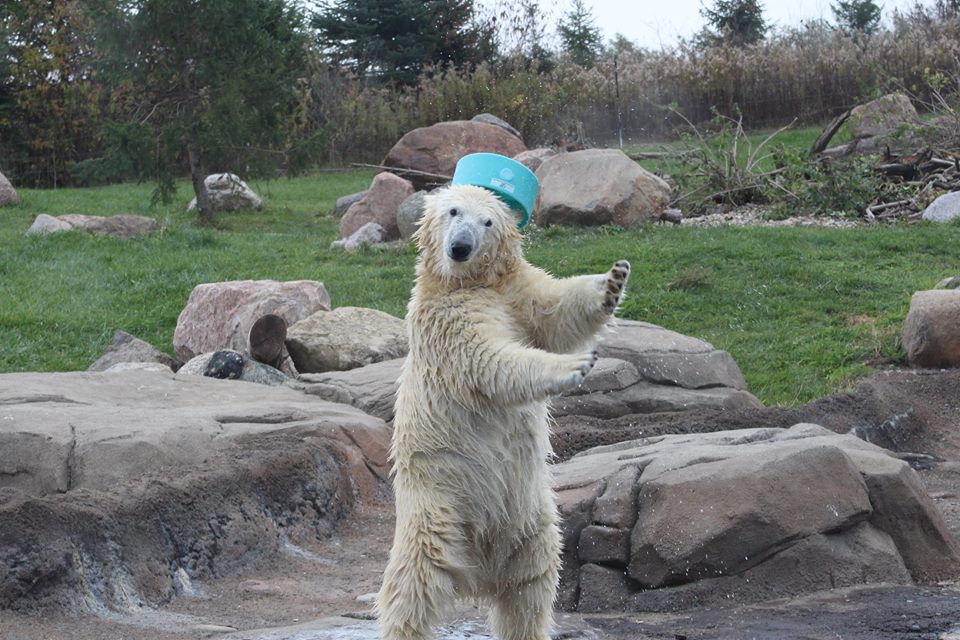
Amelia Gray Shares Her First Birthday With Polar Bear Conservation
Featured Image Credit: Facebook/ Columbus Zoo and Aquarium
By: Kira Krall
Amelia Gray the polar bear celebrated her first birthday at the Columbus Zoo on November 8, 2017. The Zoo had two reasons to celebrate our favorite arctic predator, as Amelia Gray’s birthday also falls during international polar bear week. This was a phenomenal chance for the Zoo to highlight their conservation efforts as well as give Amelia Gray some special birthday girl treatment.

Amelia Gray and her mother Aurora were treated to special birthday enrichment like the polar bear cake shown above. Guests sang Amelia a rousing round of “Happy Birthday” while they took a break from enjoying the Zoo’s polar bear week festivities. Image Credit: Youtube Screenshot
Polar Bears International launched the worldwide awareness campaign to kick off the annual polar bear migration to Churchill, Manitoba. The arctic bears make their way to Hudson Bay to await the sea ice and the seals that like to haul out onto it. Ringed seals make up most of the polar bear diet during their time in Churchill!
According to Polar Bear International, Hudson Bay and Churchill are the most accessible part of the polar bear’s worldwide range. That makes this area the most studied out of 19 in the world. The extensive study of this specific population means that the seasonal locations of the polar bears are extremely predictable, particularly for researchers and tourism companies. Polar bear tourism generates over $5,590,728 per season.
Unfortunately, the late pack ice and early melt are influencing wild polar bear populations in a bad way. Polar bears can weigh almost 4 times as much as a black bear and have an appetite to match. Without the sea ice, fat-rich seals are nearly impossible to catch. The southernmost populations have crashed by as much as 40% due to these globally increasing temperatures.
Thanks to the conservation efforts of facilities like the Columbus Zoo, scientists have been able to observe mother and cubs in their dens. Mothers can dig their den almost 10 feet under the snow, making it nearly impossible to observe wild moms with cubs.

Anana and her months-old cub Amelia Gray. Amelia gray was less than two pounds when she was born and at just a year old, she now weighs 289 pounds. The conservation efforts of facilities with polar bears have contributed a perfect environment for scientists to study mothers and their cubs right from the moment of birth. Image Credit: Columbus Zoo
Click on this link to watch a live broadcast from Polar Bear International and learn more about polar bears from polar bear scientists!