
These Marine Creatures Are Actually Benefitting From Climate Change
Featured Image Credit: NOAA
By Eva Gruber
Climate change is an incredibly complex issue that affects everything on the planet. The changes that we have seen in the past few decades all point to the tragic consequences of our dependence on fossil fuels.
With that have come unforeseen consequences and complicated changes to our planet that we are struggling to keep up with and understand. While climate change may be the last straw for the vast majority of creatures on our planet, a select few might enjoy a brief increase in population as a result of climate change.
Orca
Earth’s poles suffer from the most severe changes when it comes to a warming planet. Warming at a rate of almost twice the global average, the Arctic is especially sensitive as an ecosystem. Since the 1970s we have documented a 14% decrease in sea ice – crucial habitat for so many Arctic animals. This is incredibly bad news for many species such as polar bears and bowhead whales who rely on the formation of extensive summer sea ice.
However, the lack of sea ice can mean that Arctic habitat opens up to species that aren’t normally found there. In the case of orca, less sea ice means more hunting grounds for these top predators – and orcas have been increasingly spotted in the Canadian Arctic.
With warmer waters, they are able to travel further north, and with less sea ice they can more easily infiltrate the Arctic and prey on seals and other whales – including those in recovering populations. We obviously care about the orca, but introducing a new predator to an ecosystem where it doesn’t “belong” has drastic and unforeseen consequences on that ecosystem.
Jellies
Climate change has multivariate effects on the oceans, some of the most impactful being acidification and warming temperature. Both of these impacts might have positive effects on jelly populations, especially those nearshore. Studies have shown that coastal jelly populations are on the rise. While that might be good news for a jelly, like any imbalance this is likely to throw marine ecosystems into chaos.
Increasing jellies would mean increased pressure on plankton, which many other species rely on. This would impact the food web as while other planktivorous species might go on to be eaten themselves, jellies are generally avoided as a food item. This will essentially lock up the energy from the base of the food web, blocking the higher levels from thriving. An ocean filled with jellies is a bleak picture indeed.
Tuna Crab (Pleuroncodes planipes)
Tuna crabs also known as pelagic red crabs, are small crustaceans in the squat lobster family. They are called tuna crab because they are a favored prey item of tuna fish. They typically reach a size of about 1 to 3 inches long and spend their adult life drifting in the water column. Their legs are lined with fine filamentous hairs which capture particles of plankton. The crabs will then run their legs through their feeding appendages and glean nutritious zooplankton and protists from them.
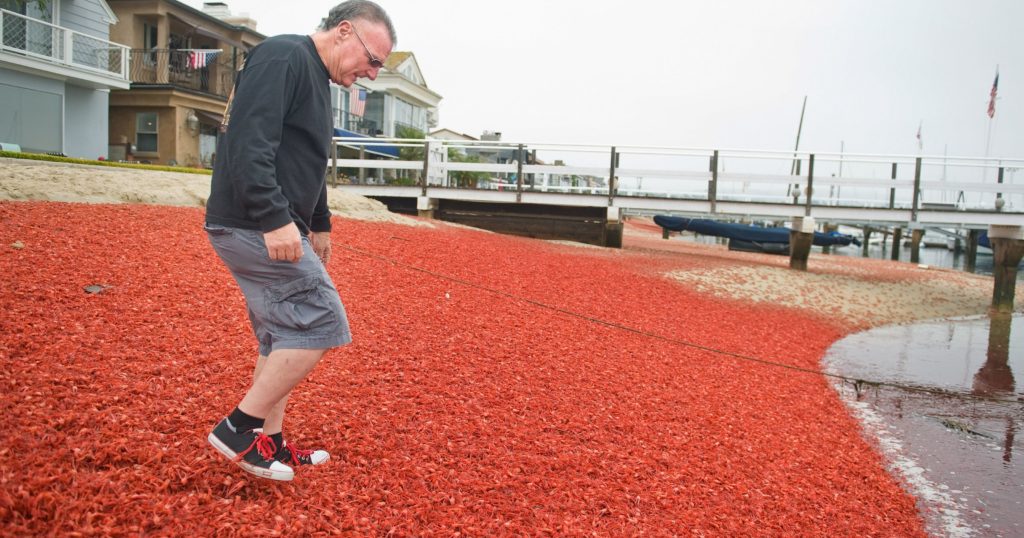
For the third year in a row, tuna crabs are washing up en masse on the beaches of Southern California. Normally these irruptions are seen every 8-10 years and are correlated with El Nino events which alters ocean temperatures and currents – but in recent years these strandings have become much more common as warmer waters flow further northward, extending the range of many southern marine creatures.
Salps
Many people might misidentify these organisms as jellies. While their bodies are gelatinous and they move by contracting, salps are actually planktonic tunicates. Salps are found worldwide, but in the Antarctic, their presence is strictly connected to the presence and extent of sea ice. Krill, which are the base of the extensive food web in the ocean around Antarctica, depend on the formation of sea ice. Sea ice encourages the growth and blooming of marine algae and phytoplankton on which the krill survive. Without sea ice, there is no phytoplankton, and then there is much less krill available for the fishes, whales, seals, and penguins.
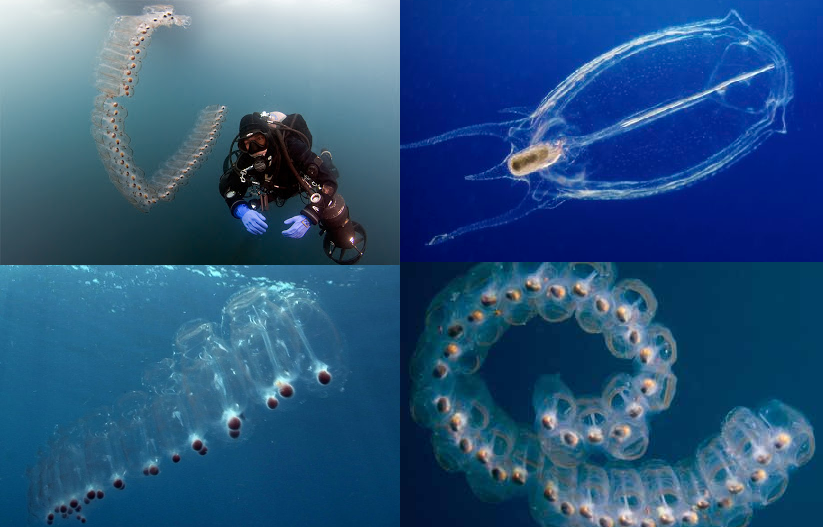
Warming conditions in the Southern Ocean favor the growth of salps over krill. Unfortunately, salps – with a body that is 99% water – are not very nutritious and are not eaten by very many organisms. To make the matter worse, the salps directly compete with organisms that eat phytoplankton – thereby essentially sequestering the base of the food web for themselves and not passing it on.
Warming oceans are causing changes to marine animals’ feeding, breeding, and ranges across the board from diatoms to blue whales. While some marine animals may initially benefit in terms of an expansion of their range, or breeding habitat, the system-wide imbalances from prey shortages to chemical changes will diminish biodiversity and resiliency of our oceans. In turn, our planet will be a frailer, less biologically rich planet – and there will be only one species to blame for it – humans.


