
Digging Up Answers To The Oyster Problem
Featured Image Credit: Jonathan Wilker/Purdue University
By Jessica Kittel
For those who haven’t heard, there’s this thing happening called global climate change. Countless numbers of species are struggling to adapt to the new environmental conditions. For many people, the image of polar bears on an exceptionally small piece of ice comes to mind. Less charismatic but equally as worrisome, is the plight of a very tasty but highly threatened bivalve, the oyster. Hakai magazine reports that over the last 130 years there has been an 85 percent drop in worldwide oyster populations.
Oysters are struggling to cope with a changing ocean. The rise of ocean acidification is having an exceptionally impactful effect on these mollusks. Ocean acidification is caused by the uptake of extra carbon dioxide from the atmosphere. The carbon dioxide reacts with the water molecules and the resulting creation is carbonic acid. Excess carbonic acid hinders the ability of calcifying creatures (such as oysters) to form calcium carbonate (shell material). The acidic water is so corrosive that it eats away at larval oysters’ shells before they even get a chance to form.
Losing oysters is an issue, not only because they taste delicious with cocktail sauce, but also because they are important contributors as ecological engineers, filtration systems, and keystone species.

Image Credit: Shutterstock
While the oyster problem would definitely be classified as a current event, some scientists are looking into the very distant past to find answers on how to combat the oyster losses. A paper by Dietl and Flessa explains that researchers in the young field of conservation paleobiology apply the theories and analytical tools of paleontology to present day issues we are facing in biodiversity conservation.
Don’t feel bad if the term conservation paleobiology doesn’t ring a bell, it was only just named in 2002. Though, scientists have been employing conservation paleobiology techniques for decades.
One of the advantages of conservation paleobiology is that it gives researchers the ability to identify events that exceed the timescales of firsthand human experience, as Dietl and Flessa explain in their paper. It is very important to get a long-term perspective on modern systems because that is essential to developing effective conservation policies.

Image Credit: Chip Clark/Smithsonian
Hakai notes that conservation paleobiology has the ability to help combat the issues associated with “shifting baselines.” Shifting baselines is centered on the idea that most people use information from our lifetime or the recent past. They use this information to determine a point of reference for what something was like before it became what is considered “degraded.” Then that baseline is used as the foundation for their idea of what the world should be like. The problem with this strategy is that anything that came after human influence was already degraded. There would be no way for us to know the state of the environment before human influence.
Yet, conservation paleobiology allows scientists to create a baseline that more accurately portrays what the environment would look like if humans hadn’t messed everything up. They are able to look into the past, using various techniques, and determine what the environment looked like way before humans were in the picture. This historical information is useful to conservationists because it ensures that their plans are ambitious enough and suited to the current environmental conditions.
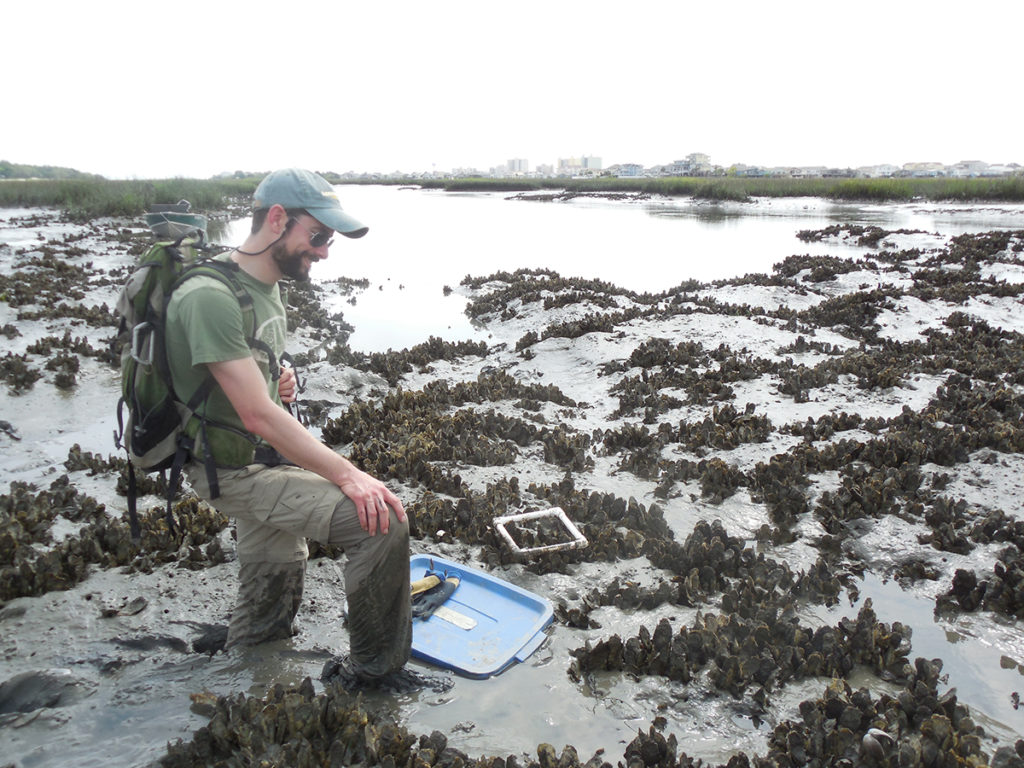
Image Credit: Jansen Smith/Cornell
It doesn’t hurt that conservation paleobiologists get to do some pretty cool stuff. For example, they use a laser to glean information on an ancient oyster, as Hakai describes. This laser measures the ratios of elements found in the fossil. By comparing ratios of elements like magnesium, calcium, and barium, they’re able to come up with information on temperature and salinity.
Some conservationists are somewhat skeptical about this new field and its validity. Dietl and Flessa explain that with the right conditions and capable paleobiologists, then they will be able to produce data and insights that will benefit conservation biology.
For the oysters’ sake, let’s hope this is the case.
Works Cited:
Dietl, Gregory P., and Karl W. Flessa. “Conservation paleobiology: putting the dead to work.” Trends in Ecology & Evolution 26.1 (2011): 30-37.
Geoffrey Giller, “What the Ancient Oyster Knows,” Hakai Magazine, September 13, 2016, accessed September 21, 2016, http://bit.ly/2bA5QFi.

