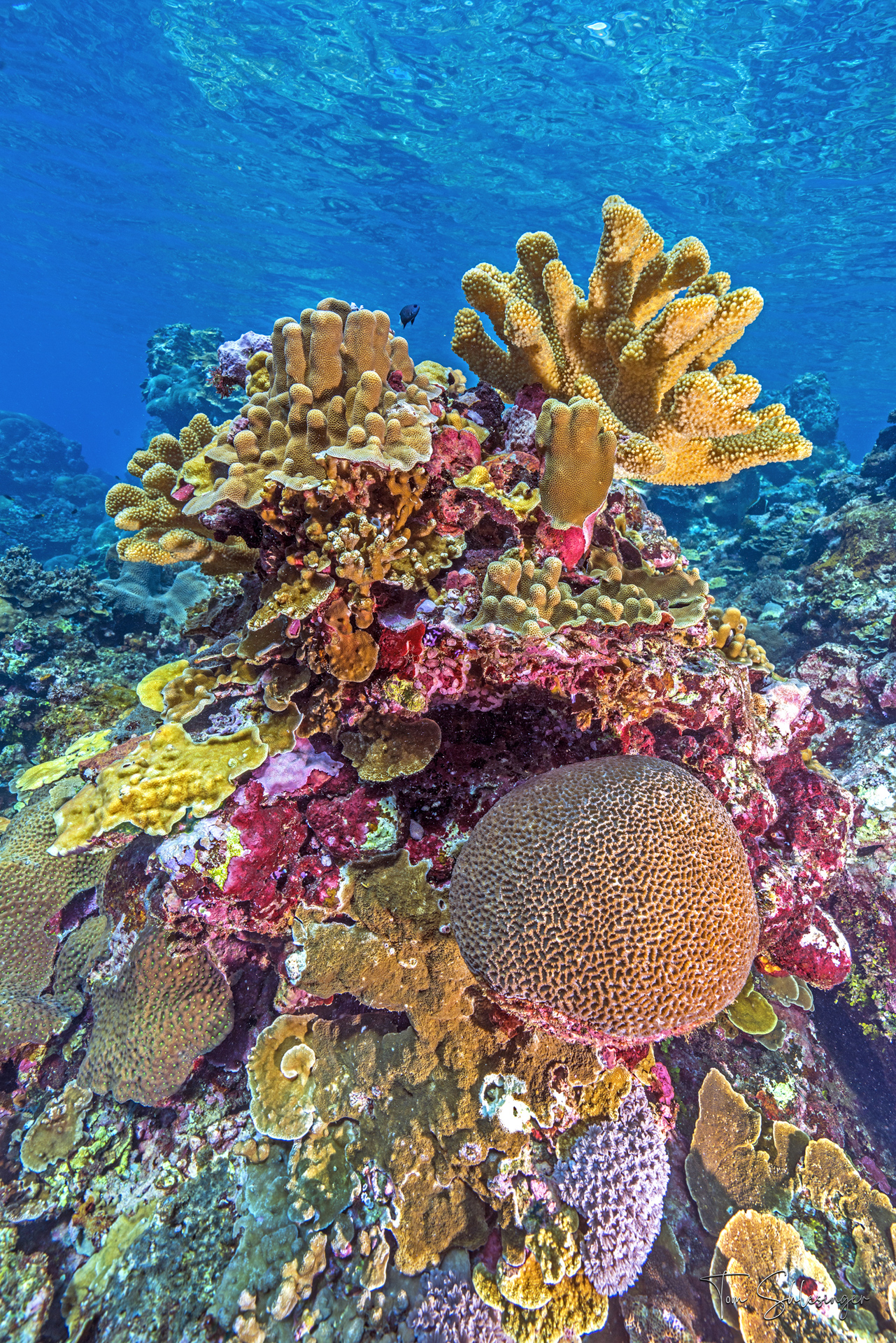
Nearly Half of the World’s Reef-Building Corals Are Now at Risk of Extinction
The corals that build the world’s reefs are disappearing faster than almost any other group of animals scientists track, and a sweeping new assessment suggests the picture is worse than the numbers show.
Of the 774 reef-building coral species with enough data to evaluate, 340, or 44%, are now threatened with extinction, according to a reassessment by the International Union for Conservation of Nature published last week in the journal Nature. Thirty-three species are Critically Endangered, 251 are Endangered and 56 are Vulnerable. When the IUCN completed its first global coral assessment in 2008, about a third of species were threatened.
The researchers stress that 44% is likely an undercount. Their data runs through 2020, before the fourth global coral bleaching event swept the planet’s reefs from 2023 to 2025, the most extensive on record. And this year’s powerful El Niño is now pushing ocean temperatures higher still.
Dr. David Obura, co-chair of the IUCN Species Survival Commission’s Coral Specialist Group and director of CORDIO East Africa in Kenya, called the study “the most comprehensive evaluation to date of global extinction risk among reef-building corals” and “a stark warning of the accelerating increase in global threats to coral reefs.”
Climate Change Is the Main Driver
More than 60 coral experts reassessed 892 species for the IUCN Red List, drawing on global trends in coral cover, projections of severe bleaching over the next three decades and the biological traits that make some species more vulnerable than others. Climate change was the deciding factor for more than 90% of the species at highest risk.
When water gets too warm, corals expel the microscopic algae that live in their tissue and supply most of their food. They turn white, a process called bleaching, and if the heat lasts too long, they starve.
The damage is not spread evenly. Half of the Atlantic species assessed are threatened, compared with 43% in the Indo-Pacific. The hardest hit group is the Indo-Pacific Acroporidae, the family that includes branching staghorn corals and plating corals, which do much of the work of building a reef’s three-dimensional structure. Of 279 species in that family, 191, or 68%, are now listed as Endangered.
“Coral reefs are experiencing rapid environmental change, but responses vary greatly among species and regions,” said Dr. Francoise Cabada-Blanco, the group’s other co-chair and a professor at the University of Portsmouth in the United Kingdom.
Falling Faster Than Mammals, Birds or Sharks
The IUCN tracks extinction risk across groups with a Red List Index, where 1 means no species is at high risk and 0 means all are extinct. For reef-building corals, the index stood at 0.96 before 1998. It fell to 0.89 in 2008 and to 0.74 in 2024.
That works out to a decline of roughly 0.07 to 0.094 points per decade. For mammals, birds, amphibians, sharks and rays, the comparable figure is between 0.002 and 0.039. Corals are sliding toward extinction several times faster than any of them.
The stakes go far beyond corals themselves. Reefs cover a tiny fraction of the ocean floor but shelter roughly a quarter of all marine species, protect coastlines from storms and support fisheries and tourism that hundreds of millions of people depend on.
A Glimmer From the Lab
The same week, researchers at Stanford University reported what they describe as the fastest documented recovery from coral bleaching. In a study published in Science Advances, Ph.D. student Danny Collins paired bleached coral fragments with healthy fragments taken from the same animal. When the two touched, microscopic channels in their tissue lined up, and algae began flowing from the healthy fragment into the bleached one within three days.
All five bleached fragments that touched a healthy partner fully recovered within seven weeks. The five that were separated by a few millimeters died. Once inside, the algae doubled about every four days, roughly ten times faster than in wild corals.
“While bleached corals may be dying, they are not dead yet,” Collins said.
The technique only works between genetically identical corals, so it cannot be applied across a reef today. The team is now testing ways to collect algae from healthy corals before a heat wave and deliver it afterward. “These new insights into how corals can naturally recover give us hope for the future,” said Fiorenza Micheli, Collins’s adviser and co-director of the Stanford Center for Ocean Solutions.
Every Fraction of a Degree
The IUCN report’s authors say the most important step remains cutting the emissions that are warming the ocean. Each increment of avoided warming, they wrote, helps preserve coral diversity and gives reefs more time to adapt. Stronger protection for the reefs that are holding up best is the second priority.
“Protecting coral reefs requires a strong scientific foundation,” said Daniela Picco, executive director of the MSC Foundation, which funded the research. Assessments of cold-water corals are still underway.
Sources: IUCN, Nature, Stanford Doerr School of Sustainability via Phys.org, Science Advances.