Scientists Put Underwater Umbrellas Over Florida Corals and the Surprisingly Simple Idea Appears to Work
Scientists trying to protect Florida’s struggling coral reefs are experimenting with a solution that looks surprisingly familiar: when the sun becomes too intense, give the corals some shade.
Researchers working in the Florida Keys have tested temporary underwater structures that function much like umbrellas, reducing the amount of sunlight reaching vulnerable coral colonies during periods of extreme heat. The approach does not cool the surrounding ocean, but a newly published study found that reducing light exposure can lessen some of the additional stress corals experience during marine heatwaves.
The experiment grew out of the devastating summer of 2023, when record-breaking ocean temperatures triggered widespread bleaching across the Florida Keys. The event caused particularly severe losses among branching corals and also damaged massive brain corals at some inshore reefs. Researchers from Nova Southeastern University wanted to know whether a relatively simple intervention could give particularly valuable or vulnerable colonies a better chance during future heat events.
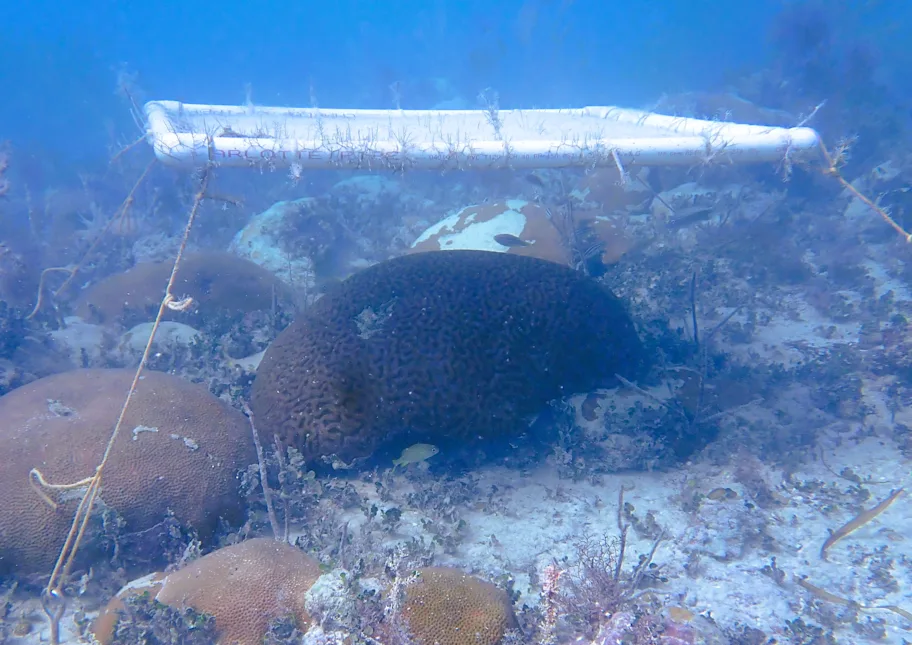
In the summer of 2024, the team installed 20 custom-built shades over 10 brain coral colonies at Newfound Harbor in the Lower Florida Keys. The experiment included knobby brain coral and boulder brain coral, while another 20 comparable colonies were left unshaded so researchers could compare how the two groups responded.
The structures were made from pipes and nylon fabric and floated about 30 centimeters above the corals. Rather than completely blocking the sun, they reduced incoming light by approximately 60 percent. Divers returned every two weeks to photograph the colonies, document changes in color and collect small tissue samples that allowed them to examine what was happening inside the corals.
Why Shade Can Help a Coral Survive Heat
Coral bleaching is closely associated with high water temperatures, but heat is only part of the problem. Corals live in partnership with microscopic algae inside their tissues, which provide much of the energy the animals need and are also responsible for much of their color. Under severe environmental stress, that relationship can break down, causing the algae to leave and the coral to turn pale or white.
Intense sunlight can make that heat stress even worse. The Florida researchers therefore wanted to determine whether reducing ultraviolet radiation and overall light exposure could provide some relief even though the shade structures could not lower the actual water temperature.
The results were encouraging. The summer of 2024 produced the second-highest heat stress recorded at the study site, yet the shaded corals generally lost less color during the most intense periods of thermal stress. Researchers also observed some previously pale colonies regaining color after the shades were installed, suggesting that the intervention may have helped them recover. Neither the shaded corals nor the unshaded control group died during the experiment, which means the study could not demonstrate whether the structures would prevent mortality during an even more severe event.
There were other limitations as well. The researchers were not permitted to install the shades until after water temperatures had already reached levels capable of causing bleaching, meaning an earlier intervention might have produced different results. They also found no significant difference between the shaded and unshaded groups in the density or type of the symbiotic algae sampled from the corals.
The scientists are therefore careful not to present underwater shading as a solution capable of protecting entire reef systems. Lead researcher Karen Neely described scaling as the major limitation, noting that temporary shades would realistically be used to protect selected colonies rather than miles of reef. There may also be levels of heat stress so extreme that reducing sunlight would no longer be enough to protect a coral.
That still leaves several situations where the idea could prove useful. Particularly important breeding colonies, rare corals, restoration sites or genetically valuable individuals could potentially be protected temporarily when forecasts indicate that dangerous heat is approaching. Instead of trying to cover an entire reef, managers could concentrate resources on corals considered especially important to future restoration and recovery.
The concept also represents a broader shift in coral conservation. Scientists are increasingly looking for ways to help reefs survive damaging events rather than waiting until after large numbers of corals have died and attempting to rebuild them. Restoration remains important, but growing new coral colonies can require years of work, and those newly restored corals remain vulnerable when the next marine heatwave arrives.
Temporary shading is unlikely to replace any of those larger efforts, and the researchers emphasize that it cannot address the underlying problem of rising ocean temperatures. What it may provide is another tool that reef managers can deploy when particular corals need immediate protection.
The simplicity is part of what makes the experiment so interesting. There is no futuristic machine surrounding the coral and no attempt to air-condition a section of the ocean. The structures essentially reduce one source of environmental stress while the coral deals with another.
After one of the most destructive bleaching events ever recorded in Florida, scientists went back underwater looking for practical ways to give surviving corals a better chance during the next extreme summer. One of the most promising ideas so far may also be one of the simplest: when the ocean becomes dangerously hot and the tropical sun makes matters worse, put up an umbrella.
Sources: Frontiers , BBC Wild Life