A Young Dolphin Was Found With Fishing Line Wrapped Around Her Tail and It Took a Massive Team to Set Her Free
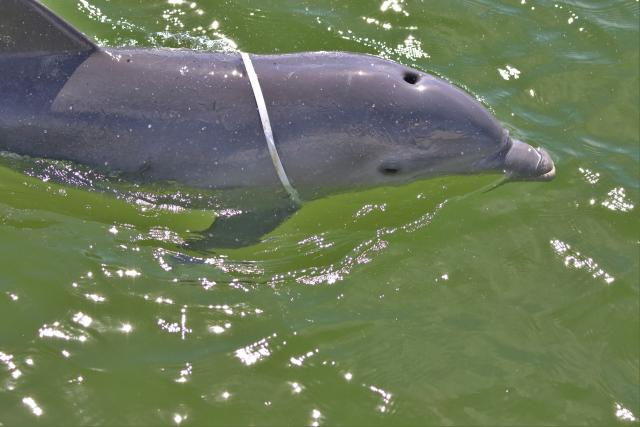
For weeks, a young bottlenose dolphin in Florida’s Indian River Lagoon was swimming around with fishing line wrapped tightly around her tail.
Researchers knew she needed help.
The hard part was getting close enough to provide it.
The dolphin was first spotted on July 22 by researchers with Hubbs-SeaWorld Research Institute, who began monitoring her condition after noticing the entanglement.
Fishing line had become wrapped around the dolphin’s tail and was causing severe injuries. Without intervention, researchers feared the situation could become life-threatening.
But rescuing a wild dolphin isn’t as simple as swimming out and cutting the line.
Dolphins are fast, powerful animals capable of quickly diving or swimming away when people approach. Even when an animal desperately needs help, it has no way of understanding that the boats and people moving toward it are there to save its life.
That means a rescue like this requires planning.
It also requires a lot of people.
On Aug. 11, a large team of marine mammal experts gathered in Brevard County for an attempt to disentangle the dolphin.
Hubbs-SeaWorld Research Institute led the response, with experts from Florida Atlantic University’s Harbor Branch Oceanographic Institute joining the operation.
They weren’t alone.
The rescue brought together NOAA Fisheries, the Florida Fish and Wildlife Conservation Commission, SeaWorld, the University of Florida, Sarasota Dolphin Research Program, Mote Marine Laboratory and Clearwater Marine Aquarium.
Each organization brought people with specialized experience in marine mammal response.
Together, they had one goal.
Get the fishing line off.
Getting Close Was Only the Beginning
Entanglement is a serious threat for dolphins and other marine mammals.
Fishing line and marine debris can wrap around fins, tails and other parts of the body. As an animal continues swimming and growing, the material can tighten and cut deeper into tissue.
NOAA notes that responding to an entangled dolphin can be especially challenging because the animal can dive and move away rapidly, making both locating and safely approaching the individual difficult.
In this case, rescuers were able to successfully secure the young dolphin long enough to work.
The fishing gear was removed.
Her injuries were treated.
And instead of beginning a long stay at a rehabilitation facility, the dolphin was able to go straight back home.
After the team finished treating her wounds, she was immediately released into the Eau Gallie River.
She also left the rescue with something she didn’t have when researchers first found her.
A name.
The team began calling her RONY in honor of Rhonda, the volunteer who spotted the dolphin on the day of the rescue.
It’s a fitting tribute because successful marine animal rescues often begin with someone simply paying attention.
A boater notices something unusual.
A fisherman sees an animal struggling.
Someone walking near the water spots fishing line where it shouldn’t be.
That observation can eventually set an entire rescue network in motion.
Florida has an especially extensive network of organizations capable of responding when dolphins and other marine mammals are injured or stranded.
FAU Harbor Branch’s marine mammal team, for example, remains on call around the clock throughout the year and responds to dolphins in Indian River, St. Lucie and Martin counties while also assisting partner organizations elsewhere in the state.
SeaWorld Orlando is also part of Florida’s authorized marine mammal response network, alongside universities, aquariums, government agencies and nonprofit research organizations.
Those partnerships matter because complicated rescues can require veterinarians, researchers, animal handlers, boat operators and wildlife officials to work together at the same time.
RONY’s rescue is a pretty good example of what that looks like.
One dolphin.
Eight organizations.
Weeks of monitoring.
And eventually, one opportunity to get close enough to help.
The actual moment of removing the fishing line may have represented only a small part of the entire operation.
But for RONY, it was the part that mattered most.
After weeks of swimming with fishing line cutting into her tail, the young dolphin returned to the river without it.
Sources: NOAA Fisheries