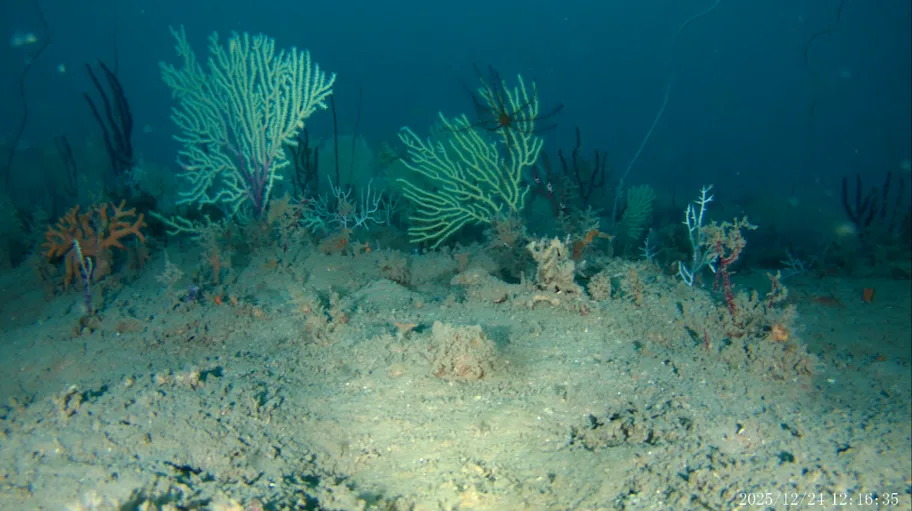
A “Dead” Coral Reef Vanished From the Map 60 Years Ago. Scientists Just Found It — Very Much Alive.
Did you know a coral reef can go missing for six decades and still turn out to be thriving? That’s exactly what just happened off the coast of Benin, in West Africa.
Back in the 1960s, surveyors mapping the Gulf of Guinea’s fishing grounds picked up hints of a reef structure deep below the surface — but concluded it was almost certainly dead, and the site was largely forgotten. That changed when Gérard Zinzindohoué, a researcher at Benin’s Institut de Recherches Halieutiques et Océanologiques, learned about the old survey and asked a simple question: does Benin actually have coral reefs?
Finding out took real persistence. After years of failed grant applications, Zinzindohoué secured a National Geographic Explorers grant and set out with modern sonar equipment and the National Geographic Exploration Technology Lab’s Deep Sea Camera System — essentially underwater trail cameras that capture life on the reef undisturbed. The team mapped over 11 kilometers of seabed, searching for signals matching the decades-old survey data.
“It was a mix of long days at sea, technical problems and a lot of uncertainty,” Zinzindohoué said. “But then we saw structures on the sonar that looked like they could be reef signatures, which gave us hope that we were close.”
What they found exceeded expectations. More than 50 meters below the surface, the cameras revealed a genuinely healthy reef — at least eight coral types and eight fish species moving through the structure to feed and shelter, including golden African snappers, blackbar soldierfish, and Guinean angelfish. Researchers classified it as a mesophotic coral ecosystem, a type of reef that lives at depths beyond where typical shallow corals survive.
Houangninan Midinoudéwa, a colleague who first shared the original 1960s report, remembers the moment the first images came through: “Bro, 60 years later we are now discovering exactly what we have in our water. We found it still alive, producing more fish for communities and supporting livelihoods.”
Why it matters: Historical data suggests this reef may be part of a much larger structure — potentially stretching nearly 25 miles along Benin’s coastline, almost entirely unexplored. It’s a genuine reminder that “presumed dead” isn’t always the end of the story, and that entire ecosystems can still be waiting to be rediscovered right off a coastline people have fished for generations.
Sixty years missing. Still alive. Still worth protecting.
Sources: frontiersin.org