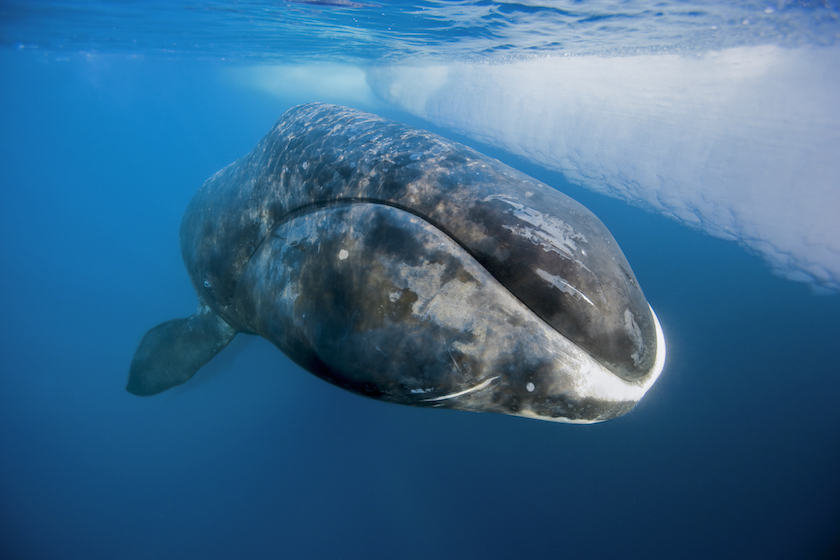
Bowhead Whale Needs A Cake With 200 Candles
Image Credit: www.thecanadianencyclopedia.ca
Humans are obsessed with finding long-living creatures.
But … why?
Perhaps we think that by finding a creature with astronomical longevity, with little evidence of age-related diseases or distress, we can gain insight into how humans can lead a long and healthy life.
Or maybe we just like strange creature aspects.
The bowhead whale can apparently (thanks to a new study) live to be over 200 years old, proving that it’s the longest-lived mammal on the planet.

Right about now, there are anywhere from 7,000 to 10,000 of these animals swimming in the sea. They are related to right whales, and like the right whale they are slow-moving filter feeders that eat zooplankton.
Bowheads also have another claim to whale fame: they are one of the heaviest mammals, reaching 100 tons.
Scientists at the University of Liverpool have sequenced the genome of the bowhead whale and compared it to those from shorter-lived mammals. Bowheads have genetic alterations related to cell division, DNA repair, cancer, and aging that may have helped increase its longevity and avoid contracting old age diseases.

“… Species evolved different ‘tricks’ to have a longer lifespan, and by discovering the ‘tricks’ used by the bowhead we may be able to apply those findings to humans in order to fight age-related diseases,” said senior author Dr. João Pedro de Magalhães.
Another contributing factor may be unique to massive mammals. Whale cells (which also number 1,000 times more than humans) have a lower metabolic rate than those of small mammals.
So in layman’s terms, here is what researchers say may contribute to the bowhead whale’s longevity:
- Genetic differences unique to their species
- 1,000 times more cells than humans
- Lower metabolic rate
Only time will tell if scientists are able to use these findings to change the way humans age.