Drone Footage Captured One of the Ocean’s Most Mysterious Whales Feeding in Indonesia
A marine biologist flying a drone over the waters of Indonesia captured a remarkable view of one of the least understood whales on Earth doing something scientists rarely get to watch in such detail.
The animal was an Omura’s whale, a slender tropical species that remained so poorly understood for so long that scientists did not formally recognize it as a distinct species until 2003. More than two decades later, researchers are still piecing together basic information about where these whales live, how many exist and how different populations are connected.
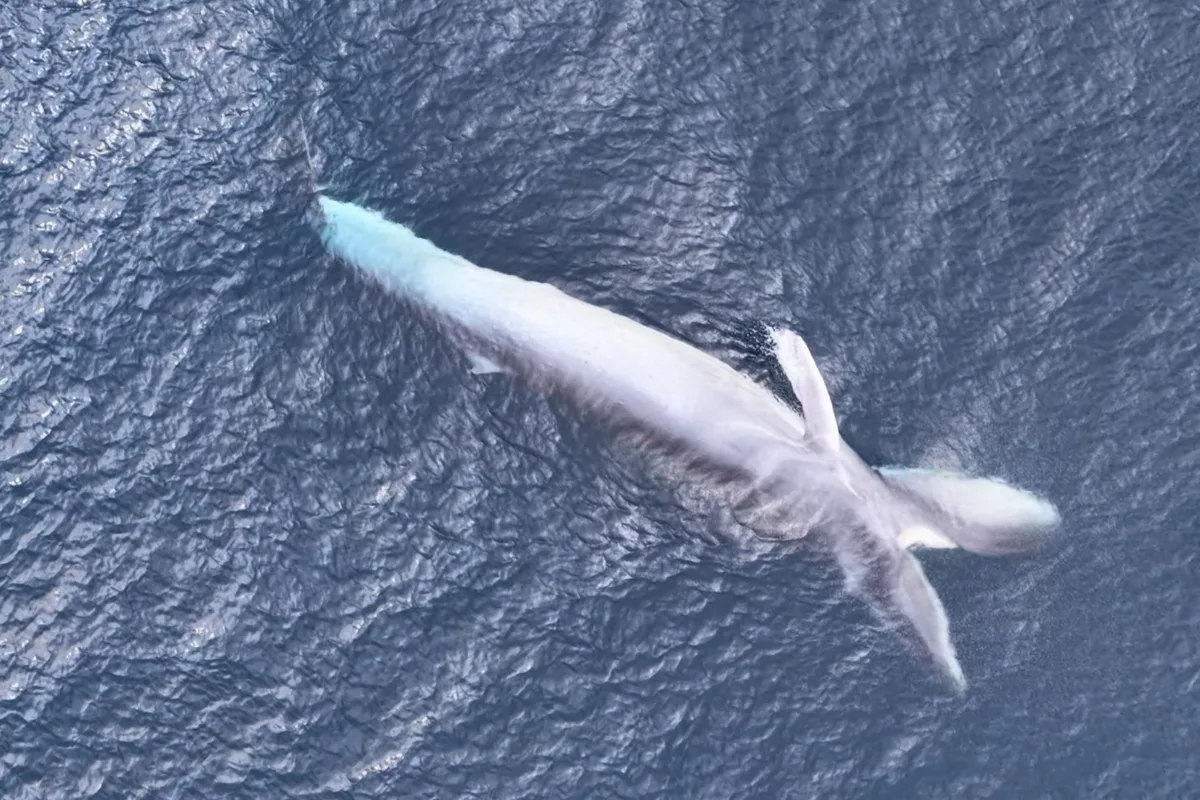
The new footage was captured by marine biologist Dr. Mark Erdmann in the Dampier Strait of Raja Ampat, Indonesia. Erdmann was aboard the MY Silolona earlier this year when crew members noticed a whale’s faint blow in the distance. He launched a drone to investigate and discovered an Omura’s whale actively feeding near the surface.
From above, the whale could be seen moving through patches of krill before lunging forward with its mouth open, engulfing a huge volume of water and prey.
It is an impressive sight from an animal that can reach around 12 meters, or nearly 40 feet, in length. Despite that size, Omura’s whales can be surprisingly difficult to find.
Their blow is relatively low and inconspicuous compared with some larger whales, and they tend to inhabit tropical and subtropical waters where systematic whale surveys can be limited. Their streamlined appearance also caused them to be confused with other similar-looking whales for years.
In fact, scientists only realized relatively recently that they had been looking at a separate species all along.
A Whale Science Almost Missed
Before Omura’s whales were formally described in 2003, specimens had often been classified as smaller forms of Bryde’s whales. Genetic analysis and detailed examination of their skeletons eventually revealed that they were distinct enough to deserve their own species designation, Balaenoptera omurai.
That discovery opened an unusual chapter in modern whale science. Researchers suddenly had an entire species of large whale about which they knew remarkably little.
For years, much of what scientists knew came from dead specimens, strandings and historical whaling records. Detailed observations of living Omura’s whales in the wild were extremely limited.
That began to change significantly in the 2010s, when researchers studying a population off Madagascar obtained photographs, video, acoustic recordings and genetic samples from living animals. Those observations helped scientists establish identifying characteristics and eventually recognize that Omura’s whales were being encountered across a much wider geographic area than previously believed.
Today, verified records stretch through tropical and warm-temperate waters of the Indian, Atlantic and western Pacific oceans.
Raja Ampat is one of those places.
Previous research has documented Omura’s whales around the Indonesian archipelago, including animals feeding and mothers traveling with calves. Some evidence also suggests that Omura’s whale populations can remain in tropical regions year-round rather than making the enormous seasonal migrations associated with species such as humpback whales.
That makes Erdmann’s observation especially interesting. He says Omura’s whales appear to be year-round residents around Raja Ampat even though many visitors never notice them.
The drone gave him a perspective that would have been difficult to achieve from the boat.
Omura’s whales are baleen whales, meaning that instead of teeth they possess plates of baleen used to filter food from seawater. When the whale in the footage encountered a dense concentration of krill, it accelerated toward the swarm and opened its mouth, allowing expandable pleats along its throat to accommodate an enormous gulp of water.
The whale then forced the water back through its baleen, trapping the tiny animals inside to be swallowed.
That feeding strategy is shared with several of its much larger relatives, including blue, fin and humpback whales. Watching it from directly above, however, allows researchers and the public to see the mechanics of the behavior with unusual clarity.
There is another reason footage like this matters.
Omura’s whales remain difficult to assess from a conservation standpoint because scientists still lack fundamental information about their abundance. A major review of their global distribution found records from dozens of locations but also emphasized that some populations may be small and geographically isolated.
Researchers have documented potential threats including entanglement in fishing gear, ship strikes, hunting and industrial development in coastal areas. Because the species often occurs relatively close to shore, Omura’s whales can overlap with some of the busiest human environments in tropical seas.
Understanding where they consistently feed, breed and raise calves is therefore an important part of understanding how vulnerable individual populations might be.
Raja Ampat is already famous for extraordinary marine biodiversity. Its reefs support manta rays, sharks, sea turtles and an enormous variety of reef fish and corals, but the presence of a little-understood whale adds another layer to an ecosystem already considered globally significant.
It also demonstrates how much scientists can still learn about animals that would seem impossible to overlook.
An Omura’s whale can approach the length of a city bus. It breathes air at the surface. It inhabits coastal waters in multiple parts of the world.
And yet science did not formally recognize it as its own species until the 21st century.
Now, every clear observation helps fill another gap.
This time, it came from a faint puff of air spotted from a boat in Indonesia. A drone went up, the whale began feeding and researchers got another glimpse into the life of an animal we’ve only recently learned how to recognize.
There aren’t many 40-foot animals left on Earth that can still be described as mysterious.
The Omura’s whale is one of them.
Sources: DiscoverWildlife