Humans Are Taking The “Sea” Out Of “Seagull”
By: Kira Krall
It’s no secret that humans have been dramatically changing the environment around them for hundreds of years. But it’s more than us cutting down trees to build neighborhoods and shopping malls.
Our daily proximity to wildlife is changing how animals are behaving and interacting with their environment. And it seems that more and more seagulls are popping up in landlocked cities and towns because of us.
This study took a look at the rising populations of city-dwelling gulls in the Netherlands. Out of 710 observed trips made by these seagulls, only 2 were made to the North Sea.
They analyzed the fecal matter of their research birds and concluded that none of them were getting any sustenance from the sea. Their diet was sourced almost exclusively from fisheries’ dumps.
The study came under public scrutiny for using the term “seagull” in the first place. Gulls are actually a large family of scavenging birds found all over the world. To examine the distribution and behavior of all 40 species would be impossible for one study, so another set of researchers focused on just two: herring gulls and lesser black back gulls in the United Kingdom.
They began their study with a little history lesson. Pre-World War Two, seagull sightings in urban areas were rare. But since the end of that War, seagull sightings have spiked. And we have landfills to blame.

Seagulls in Albury landfill. Image Source: http://www.warrenphotographic.co.uk/07246-seagulls-in-albury-landfill
In the above photo, you can see just how many seagulls visit a landfill at any given time. To give you an idea of scale, 90,000 gulls visited 7 landfills in Tampa, Florida over only two months.
There’s even a Dirty Jobs episode about managing these “garbage gulls.”
While landfills are drawing gulls inland, that’s not what’s keeping them there. Urban buildings provide a high nesting spot away from predators. And season after season, more and more gulls are discovering these safe nesting hideaways.
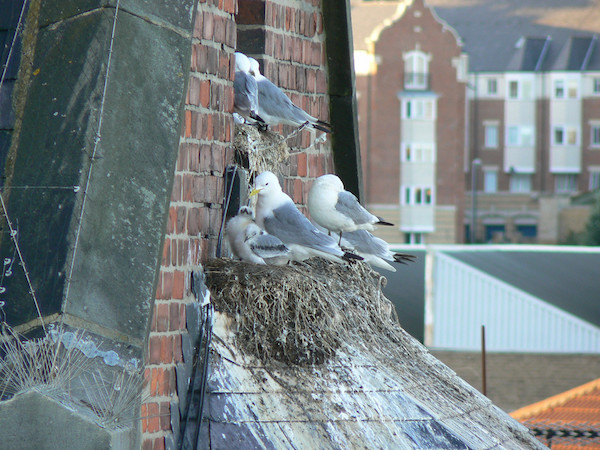
Nesting. Image Source: http://www.gdwroofwall.com/seagull-control.php
Seagulls breed in colonies. Once one pair nests, the rest of the colony will follow. And since 25,000 birds can be in a single colony, you’re looking at a large-scale nuisance.
Seagulls are aggressive nesters and will attack people if they get too close to the nest. Their nesting debris and feces can attract parasites and bugs to residential and commercial buildings, and can even damage the structures themselves.
In 2000, there were 239 nesting colonies in the United Kingdom and Ireland. In 2015, there were 473 nesting colonies.
Once these birds become established in a city, they won’t return to their natural nesting grounds. Urban seagull populations will continue to rise unless we start thinking differently about our garbage.
Cover photo source