
It’s Official – Living Fossils Are Way Cooler Than Dead Fossils
Featured Image Credit: Laurent Ballesta
By: Jessica Kittel
It’s pretty exciting when you come across a fossil on a beach walk but it’s extra exciting when you come across a living fossil like they did just off the coast of Portugal this past summer.
The late, great Charles Darwin first coined the term “living fossil”. (CITE Lee 2006; Lloyd 2011) While there’s no official definition, a living fossil is essentially an extant species belonging to an old lineage that has undergone slow rates of evolutionary change in terms of diversification into new families and genera over great periods of time. In other words, an animal that appears unchanged by time, physically resembling their fossilized ancestors.

Image Credit: Wikipedia
It is a common misconception that these animals have stopped evolving. This is of course not the case since all animals are constantly evolving. These creatures are just evolving at such a slow rate that you can hardly tell they’re doing so until closer inspection, usually at a genomic level.
There are multiple types of fish that are classic examples of living fossils including lungfish, coelacanths, goblin sharks, and frilled sharks.
(CITE Joss 2005) Living lungfish were “rediscovered” in 1837 prompting Charles Darwin to dub them as living fossils. They can be found in the fossil record dating back to the Devonian (400 mya), when they diverged from the lobe-finned fish ancestors that would eventually give rise to the ancestral tetrapods (four-limbed vertebrates). This means that lungfish are the closest living relatives to tetrapods and, well, we are tetrapods (we should probably send them an invite to Thanksgiving dinner next year). (CITE Joss 2005) The early to middle Devonian had a plethora of lobe-finned fish however all are now extinct with the exception of six species of lungfish and two species of coelacanth.
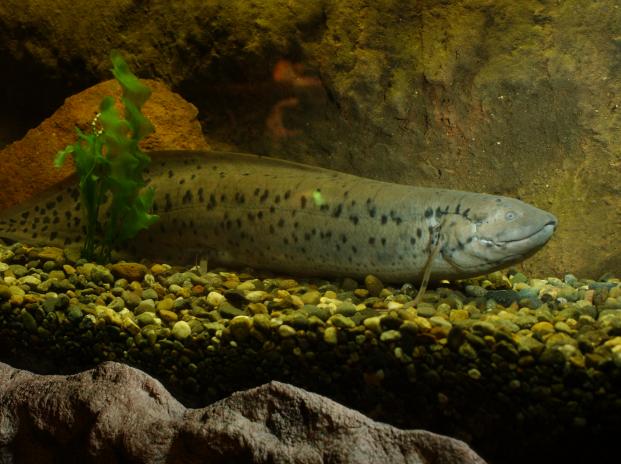
Image Credit: oregonzoo.com
The Coelacanth is another Living fossil that is actually very closely related to the lungfish but was believed to have died out during that mass extinction event that also led to the extinction of the dinosaurs. Flash forward to 1938 and “surprise, we’re still alive!” The first living coelacanth discovered by humans was off the coast of South Africa and since then there have been multiple interactions with these dino-looking fish. (CITE Fricke 1997) They lead a slow-paced life as is evident by their resting oxygen consumption values which are the lowest to be found in the fish world. Low oxygen consumption allows the fish to save energy however it also means that it has to live an extremely sluggish life.
Now, on to the sharks. Two of most primitive extant shark species around is the goblin shark and the frilled shark. And, boy oh boy, do they sure look primitive.
Goblin sharks look like something straight out of a horror film. With long, slender teeth, their jaws are highly specialized and project from the head. Yes, they can push their jaws out of their face and it does not look comfortable. (CITE Compagno) Their jaws are propelled when a double set of elastic tensioning ligaments relaxes at the mandibular joint and retracted when the ligaments are stretched. This unique jaw functions like a catapult when capturing prey.
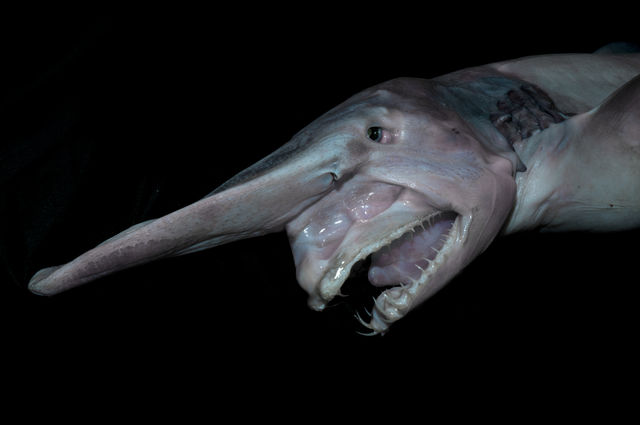
Image Credit: http://endlessocean.wikia.com
Finally, we come to the frilled shark. This is the species that was found off of Portugal this past summer. The frilled shark is a member of the oldest extant shark lineage. (CITE Tanaka et al. 2013) The frilled shark has many unique features including elongated and eel-like body, low dorsal fin, blunt snout, long jaws that are narrower at the tip than the corners, terminal mouth, similar upper and lower teeth with three strong cusps, a pair of intermediate cusplets, gill clefts with frilly margins, and the first gill slit extending across the throat. (CITE NEWSWEEK.COM) These sharks are usually discovered at depths anywhere from 390 to 4,200 feet, which is probably one of the main reasons a living specimen was never found by humans until the 19th century. The one caught off Portugal was roughly five feet long but they can grow to be over six feet long. This species of shark is also thought to have an exceptionally long gestation period of 42 months (no thank you). The moniker is derived from their frilly looking gills that stretch all the way across their throat.

Image Credit: Wikipedia
I’d say it’s pretty safe to say that living fossils are AWESOME!
Work Cited
Compagno, L.J.V. 1984. Sharks of the world. FAO Fisheries Synopsis 4:249.
Fricke, H. 1997. Living coelacanths: values, eoc-ethics and human responsibility. Marine Ecology Progress Series 161:1-15.
Joss, J.M.P. 2005. Lungfish evolution and development. General and Comparative Endocrinology 148:285-289.
Lee, J., J. Alrubaian & R.M. Dores. 2006. Are lungfish living fossils? Observation on the evolution of the opioid/ orphanin gene family. General and Comparative Endocrinology 148: 306-314.

