This Man Is About To Face His Most Challenging Swim Yet
Featured Image Credit: Ken Kostel via Woods Hole Ocean
By Eva Gruber
Endurance swimming is about as challenging as it gets in the world of extreme sports. The distances that endurance swimmers log are mind-blowing – which makes sense because in order to swim these distances many swimmers must learn to disassociate their mind from their body. It is well known that endurance swimmers stretch the very boundaries of human physiological and psychological limits.

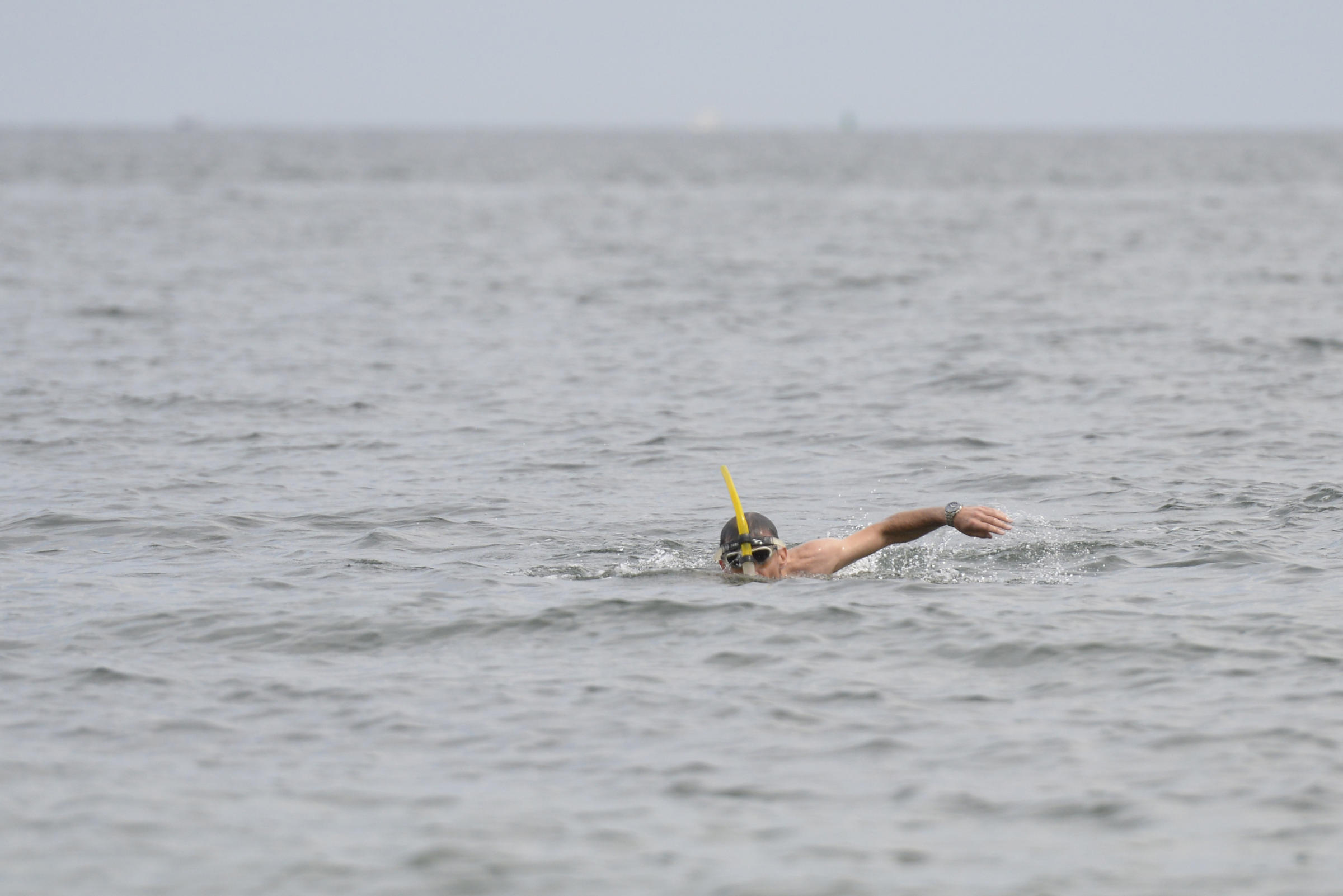
Benoit Lecomte swam the Atlantic Ocean in a total of 73 days in 1998. Image Credit: The Guardian
And yet, there are many endurance swimmers in the world today. Diana Nyad made headlines when she became the first person to swim from Cuba to Florida without the use of a shark cage. She swam 110 miles from Havana to Key West, non-stop for 53 hours. Nyad did this all at the age of 64, after four previous failed attempts.
Benoit Lecomte, pictured above, was the first person to swim across the Atlantic Ocean in 1998, swimming a total of 3,700 miles over the course of 73 days. The Pacific Ocean will be a much greater challenge – his projected path from Tokyo to San Francisco is 5,500 miles long, and the Pacific is anything but pacific.
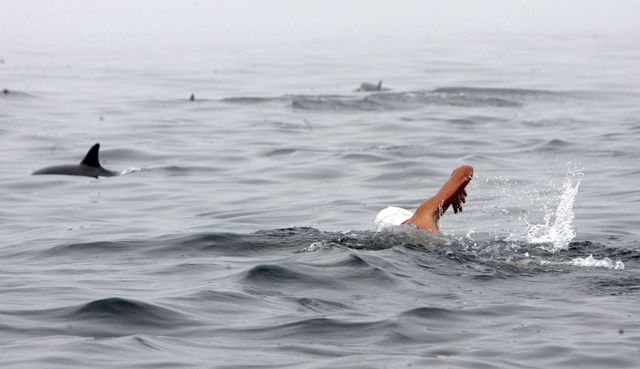
Image Credit: openwaterpedia
Endurance swimmers face many challenges and many dangers during their epic voyages. Hypothermia is a real risk when spending hours at a time in cold ocean water. Weather can quickly take a turn for the worse, leading to rough seas, punishing winds, and enormous waves. Oceanic currents can push a swimmer back farther than they can swim forward, meaning that some days or even weeks at a time, there is no gain in distance.
Maritime storms might make swimming impossible for days at a time. Hazards in the form of venomous jellies or predatory sharks are very real, and something major to consider.
With the radar and satellite technology that we are equipped with in modern times, Lecomte’s supporting vessel should be able to direct the best path to take in order to avoid storms or uncooperative currents. To provide some safety from sharks, Lecomte will be wearing an electromagnetic bracelet which is purported to work by repelling sharks (who have very sensitive electroreceptors).
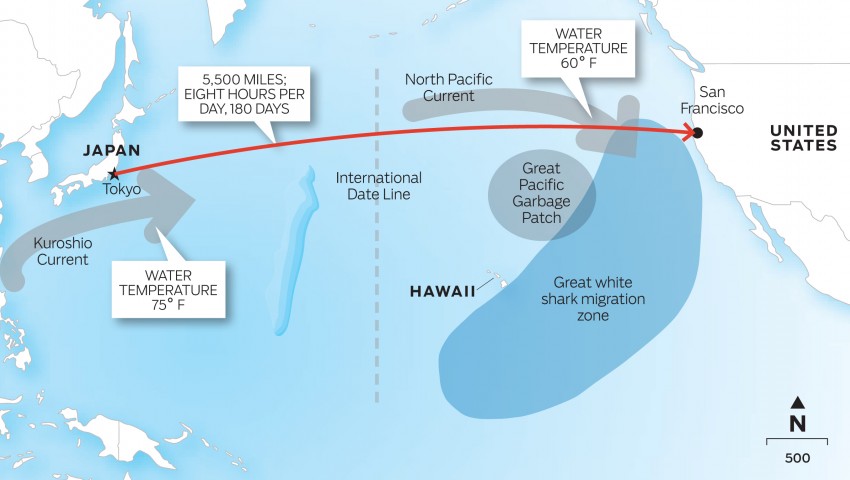
The distance across Benoit’s planned path across the Pacific. Image Credit: outsideonline.com
Lecomte actually hopes to see sharks during his swim across the Pacific. Having swam in the ocean all his life, he has seen first-hand the diminishing populations of marine life, and he knows that not seeing a shark would be a harbinger of their severely reduced populations. A large part of the reason of the planned swim is to raise awareness about issues concerning sustainability and the health of the ocean. Much of his journey will take him through the Pacific Garbage Patch.
But perhaps the most difficult part of the journey will be the challenge of swimming alone eight hours a day, nonstop, for five to six months. Lecomte has been training in meditation and other techniques to be able to dissociate his mind from his body.

Image Credit: Ben Garrett
“The challenge is to keep your mind sane and to be focused. It’s mind over matter,” he said. “Before going in the morning I know exactly what I am going to do with my mind, hour by hour. I’ll be making my own movies, creating my own buildings, and reliving moments I lived in the past and engaging all my senses so I can remember what I was doing very precisely. Remembering how the smell was, how the wind was, the sun on my skin, to be very detailed about all those elements. Then you get transported into a particular day.” He plans on swimming approximately 40 miles per day, and will be wearing a GPS logger to ensure accuracy in setting this unprecedented record.
Lecomte will be accompanied by the sailboat Discovery, which he purchased exactly for this purpose, and its eight-person crew. They will be using scientific instruments provided by NASA and the Woods’ Hole Oceanographic Institution to gather samples across their entire path.
Work on the sailboat is underway, and Lecomte will soon announce the date of his planned attempt. For more information, follow The Longest Swim on Facebook and online.