Marine Animals Are Get Bigger and Bigger
Photo credit: BBC News
A new survey on marine life past and present has determined these animals have been getting bigger since the Cambrian period.
The growth pattern suggests bigger animals generally fare better at sea, favored by evolution.
This study found that the average size of a marine animal has grown by a factor of 150 in the past 542 million years.
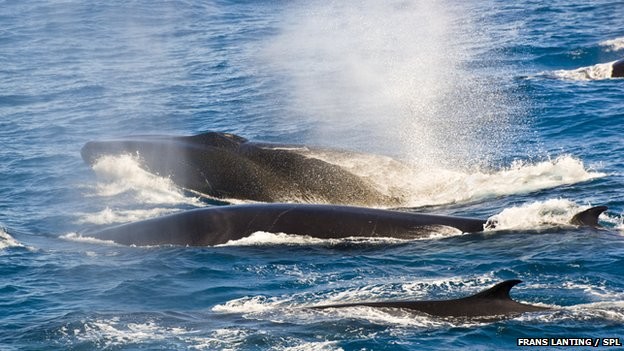
Can you believe that today’s blue whale is more than 100,000 times larger than the largest animal in the Cambrian.
American fossil specialist Edward Drinker Cope – known for Cope’s rule – was the first to suggest natural selection as a cause of the weight gain.
Paleontologists in the 19th Century also noticed that the ancestors of horses where smaller than the modern mammal. But this pattern is not consistent among all animal groups.
Most dinosaurs got bigger before their eventual extinction, but their bird relatives have evolved into smaller creatures. They’re also lighter, but as a necessity of flight.
Stanford University’s Dr. Noel Heim set out to give Cope’s rule a thorough test in the vast realm of the ocean, using the 50-volume Treatise on Invertebrate Paleontology as a key source.
“We’ve had at least 50 high school students working on it over the last five years,” Dr Heim told BBC News. “It would have taken many, many, many more years doing it on my own!”
The team amassed more than 17,000 groups of species, representing 60% of all animal genera. The analysis revealed the growing size trend, but Dr. Heim and his colleagues say the trend does not mean that every single genus of animals evolved to grow larger.
“The degree of increase in both mean and maximum body size just aren’t well explained by neutral drift,” said Dr Heim. “It appears that you actually need some active evolutionary process that promotes larger sizes.”
Read more from our source, BBC News.