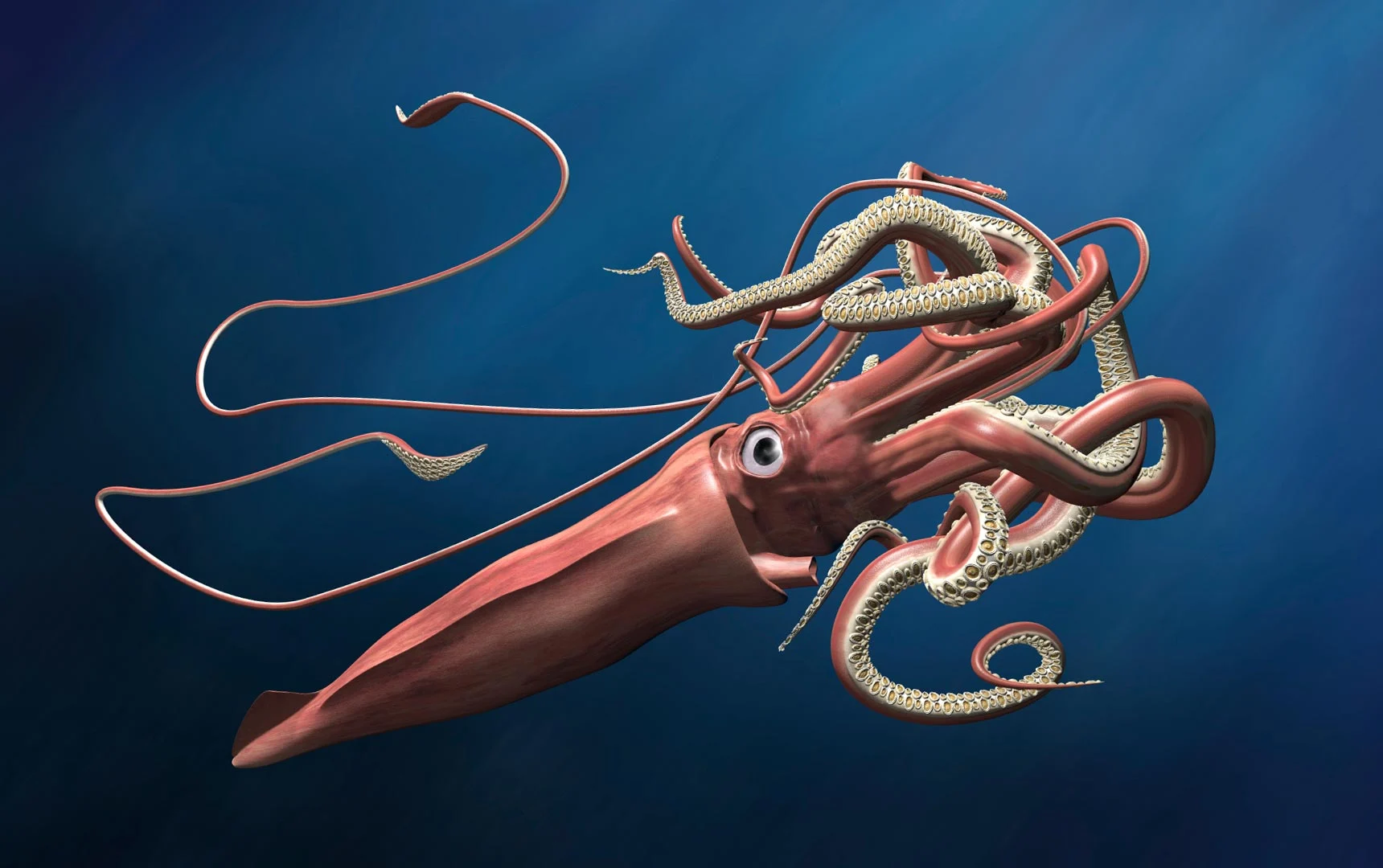
Scientists Found the Legendary Giant Squid Off Australia — Without Ever Actually Seeing One
Did you know you can prove a giant squid was somewhere without ever laying eyes on it? A team of Australian researchers just did exactly that, using nothing but a few liters of seawater.
Giant squid are some of the most mysterious animals on Earth — they can grow longer than a school bus, weigh up to 275 kilograms, and have the largest eyes of any animal alive, yet almost nothing is known about how they actually live. Scientists exploring deep underwater canyons off Western Australia’s Ningaloo coast just added a real data point to that mystery, using a clever technique called environmental DNA, or eDNA.
Here’s how it works. Every animal sheds tiny genetic traces into the water around it — skin cells, mucus, waste. Scientists filter seawater samples and search that genetic material for matches against known species, essentially reading a fingerprint the animal left behind without ever needing to see, catch, or photograph it. A Curtin University-led team collected more than 1,000 samples from the Cape Range and Cloates canyons, at depths reaching over 4,500 meters, and found genetic traces of giant squid in six separate samples across both canyons.
It’s the first confirmed giant squid record off Western Australia using this method, and the northernmost giant squid detection ever recorded in the eastern Indian Ocean — only the third giant squid record for the region in over 25 years.
And the squid wasn’t traveling alone. In total, the eDNA survey turned up 226 species across the two canyons, including deep-diving whales like the pygmy sperm whale and Cuvier’s beaked whale, alongside fish and invertebrates that may be entirely new to science. Each depth zone had its own distinct mix of species — a sign that even a small stretch of deep ocean holds far more variety than anyone had mapped before.
“Deep-sea ecosystems are vast, remote and expensive to study, yet they face growing pressure from climate change, fishing and resource extraction,” said senior author Zoe Richards, associate professor at Curtin’s School of Molecular and Life Sciences. “You can’t protect what you don’t know exists.”
A legendary sea monster, confirmed present, without a single photograph. That’s how much more there still is to learn about the deep.
Sources: scitechdaily