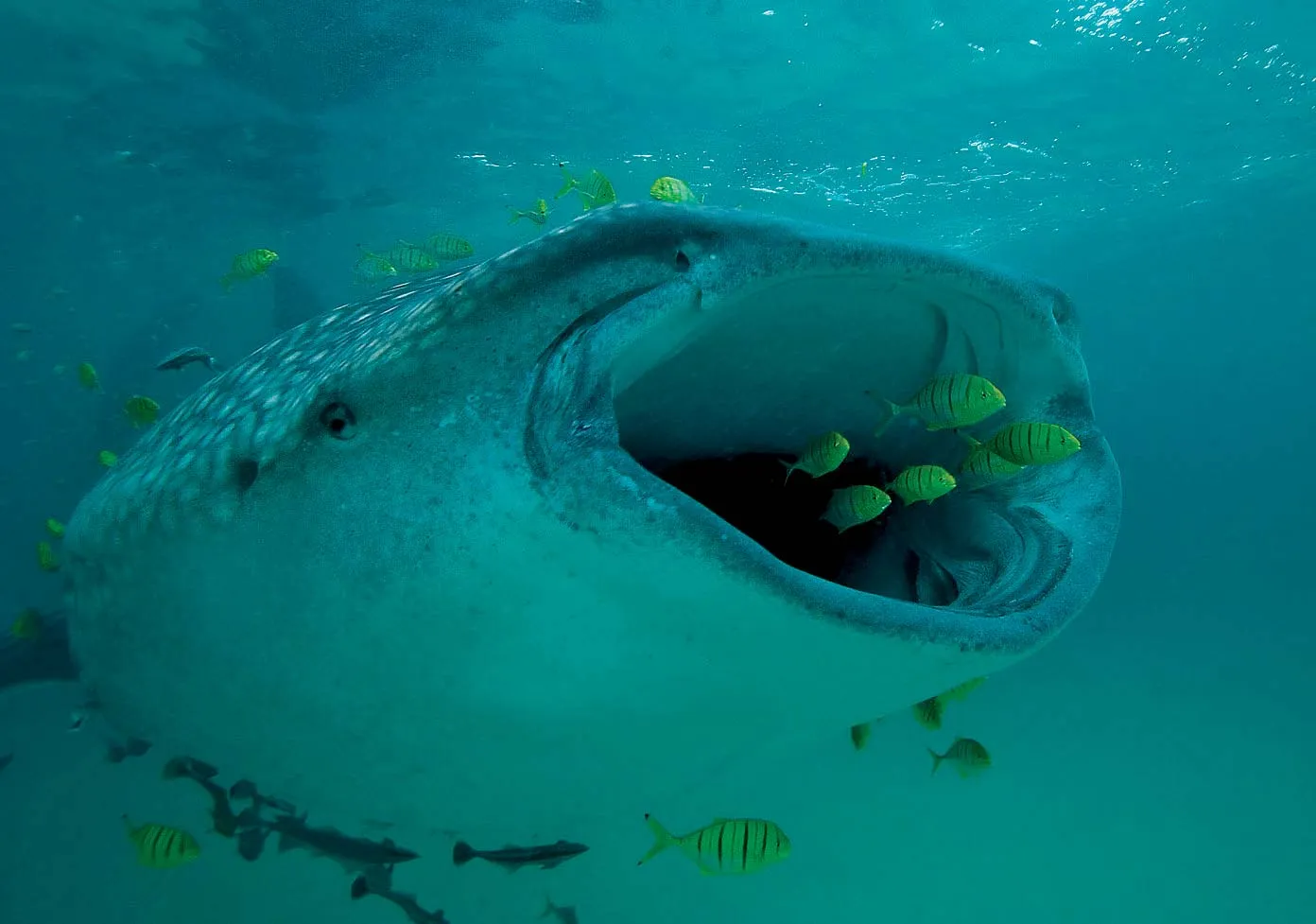
Scientists Put Cameras on Whale Sharks. It Turns Out They’re Basically Always Snacking.
Whale sharks are the largest fish in the ocean, capable of growing longer than a school bus. But despite their enormous size and worldwide popularity, scientists have spent surprisingly little time seeing the ocean from a whale shark’s perspective.
So researchers decided to change that.
Scientists from the Australian Institute of Marine Science and Murdoch University attached small cameras and tracking devices to whale sharks gathering at Ningaloo Reef in Western Australia, allowing them to follow the animals after they disappeared beneath the surface. What they discovered was an animal with a remarkable number of ways to accomplish one very important task: finding its next snack.
The research identified 36 distinct whale shark behaviors, creating what researchers describe as the most comprehensive behavioral catalogue ever assembled for the species. Twelve of those behaviors involved feeding, including six that had never previously been documented by scientists.
For an animal that survives largely by eating some of the smallest creatures in the ocean, it appears whale sharks have become exceptionally good at finding food.
Studying whale sharks comes with an obvious problem. Humans can watch them from boats or swim alongside them near the surface, but eventually the shark dives and the observation ends. That means much of what scientists have traditionally known about whale shark behavior comes from the relatively small portion of their lives that happens within human view.
The cameras changed that.
Researchers attached camera-equipped tags to the dorsal fins of five juvenile whale sharks at Ningaloo Reef. The devices recorded the animals’ movements and provided footage from the sharks’ perspective before automatically detaching after about 24 hours.
Combined with a review of more than 100 scientific publications, the footage allowed researchers to document behaviors occurring throughout the water column and along the seafloor, including at depths of around 70 meters.
Some of those behaviors had never been seen before. One, described as “gliding slow feeding,” involves the whale shark essentially sinking through the water with its mouth open, allowing food to come to it with relatively little effort. Another, called “dive feeding,” involves the shark swimming directly toward the seafloor while collecting prey along the way.
At other times, the famously relaxed-looking giants become considerably more energetic. Researchers captured whale sharks actively pursuing dense swarms of krill near the surface when the opportunity presented itself.
The result is a feeding strategy that looks less like sitting down for three big meals and more like snacking throughout the day.
The Biggest Fish in the Ocean Has a Tiny Menu
That constant search for food makes sense when considering the strange mismatch between the size of a whale shark and the size of its prey.
Whale sharks can grow to enormous proportions, but they are filter feeders. Rather than hunting large fish or marine mammals like many people might expect from an animal with “shark” in its name, they primarily consume tiny prey such as plankton, copepods and krill.
Researchers found that the sharks spent much of their observed time using relatively low-effort feeding techniques. When food was scattered, they could continue collecting small amounts without burning unnecessary energy. When they encountered a concentrated patch of prey, such as a swarm of krill, they could switch to more active feeding.
That flexibility could be particularly important in tropical waters, where food can be widely scattered and unpredictable.
“It’s not surprising that the biggest fish in the oceans is so food oriented, given they eat some of the smallest prey,” lead author Christine Barry, a PhD candidate at AIMS and Murdoch University, said when the research was announced. “But what we didn’t realise is just how many ways they go about it.”
Researchers also found that whale sharks appear to have a wider variety of feeding strategies than other giant filter feeders, including basking sharks and baleen whales.
The study also highlights how much remains unknown about one of the world’s most recognizable marine animals. Whale sharks are found throughout tropical and warm-temperate oceans, but much of their lives takes place far from shore or at depths where people cannot simply follow them. Even basic questions about their behavior, movements and reproduction remain areas of active research.
Ningaloo Reef offers scientists an unusual opportunity because whale sharks gather there seasonally in significant numbers. Researchers described the protected waters as something of a “safe pantry,” where the sharks can take advantage of feeding opportunities while scientists study their behavior.
The latest research only followed a small group of juvenile whale sharks at one aggregation site, so scientists are not assuming every whale shark around the world behaves exactly the same way. Future camera deployments at other locations could reveal entirely different behaviors.
For now, however, scientists have been given an unusually intimate look at what the world’s biggest fish gets up to after disappearing beneath the waves.
Apparently, a significant portion of the answer is looking for something to eat.
Honestly, relatable.
Sources: Australian Geographic,Australian Institute of Marine Science