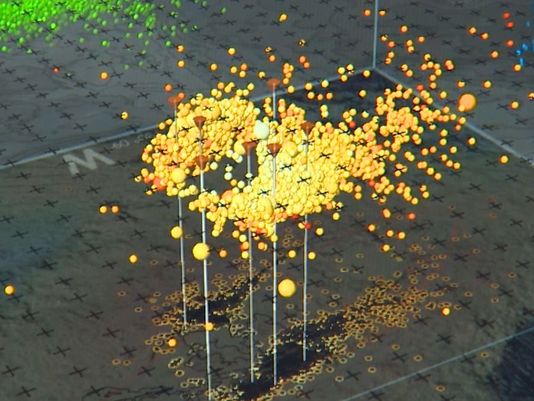
High-Tech Sensors Record Underwater Volcanic Eruptions
Photo credit: OceanNews.com
If a volcano erupts on the ocean floor, would you know about it?
Thanks to some high-tech instruments placed near the Axial Volcano by the University of Washington … that answer is yes!
The Axial Volcano is 300 miles west of Astoria, Oregon on the Juan de Fuca Ridge. These special sensors placed in the area are bringing real time information from beneath the waves to scientists on land.
“It was an astonishing experience to see the changes taking place 300 miles away with no one anywhere nearby, and the data flowed back to land at the speed of light through the fiber-optic cable connected to Pacific City — and from there, to here on campus by the Internet, in milliseconds,” said John Delaney a UW professor of oceanography who led the installation of the instruments as part of a larger effort sponsored by the National Science Foundation.
Seismic activity recordings show activity from midnight on April 23 until noon the following day.
UW marine geophysicist William Wilcock documented some increasing rumblings in the area. Quakes increased in frequency until they’re were thousands in a 24 hour period.
Then the center of the volcanic crater dropped 6 feet in 12 hours.
“The only way that could have happened was to have the magma move from beneath the caldera to some other location,” Delaney said, “which the earthquakes indicate is right along the edge of the caldera on the east side.”
Pretty cool, right? Especially considering that without the sensors, we would have no idea when this happened!
Oceanographer Bill Chadwick has been tracking this volcano and predicted there would be an eruption in 2015. It most recently erupted in 1998 and 2011.
“This exciting sequence of events documented by the OOI-Cabled Array at Axial Seamount gives us an entirely new view of how our planet works,” said Richard Murray, division director for ocean sciences at the National Science Foundation. “Although the OOI-Cabled Array is not yet fully operational, even with these preliminary observations we can see how the power of innovative instrumentation has the potential to teach us new things about volcanism, earthquakes and other vitally important scientific phenomena.”
Read more on oceannews.com.