
Italy’s Got Its Own Titanic – Meet The SS Andrea Doria
Featured Image: Source
By: Jessica Kittel
The tale of the SS Andrea Doria shares a weird number of similarities with that of the tragic RMS Titanic.
The Andrea Doria was a large passenger liner, built for luxury and heading for New York. She was considered to be one of the prides of the Italian fleet, with a level of luxury and engineering that was comparable to what Titanic was flouted to be in her day. She even had three outdoor swimming pools!
She was also, in theory, unsinkable with 11 watertight compartments that would allow her to stay afloat, even if two of them were breached.
She, like her ill-fated British cohort, would prove that this was far from the case. Nearly 44 years after the Titanic met her icy end, the SS Andrea Doria would sink on July 26, 1956.
We’re just going to throw this one out there: People should probably stop tempting fate by claiming boats are “unsinkable.”
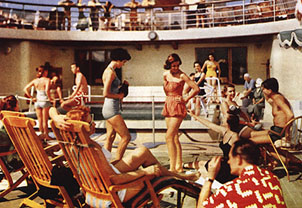
Poolside on the SS Andrea Doris
Photo Credit:Source
Despite these basic similarities, it’s really the differences between the Titanic and the Andrea Doria’s stories that stand out:
1) The Andrea Doria was a bit of a veteran.
By her fateful final voyage in 1956, she’d already passed her 50th crossing.
2) She was T-boned.
The Andrea Doria met its end in a case of tragic miscommunication. Instead of hitting an iceberg, the Andrea Doria was hit by the Swedish liner MS Stockholm at a nearly 90-degree angle.
Fog was a major factor, making the the boats unseeable to the other. Both boats could see each other on their radars, but failed to communicate their game plan. So instead of turning away, they turned towards each other.
As a result, the bow of the Stockholm hit the Andrea Doria smack-dab in the starboard side. Following this collision, the now standard maritime rule that two boats passing head-on must pass starboard-to-starboard, was put into place.

Photo Credit: Source
3) She had enough lifeboats!
There were enough lifeboats for everyone on board, however, half were inaccessible due to the tilting of the boat. As a result, all lifeboats on the port side were too high off the water to be accessible.
4) It took a while to capsize.
While it took the Titanic just under 3 hours, the Andrea Doria was hit at 11:10 pm and stayed on the surface until 11:09 am the following morning. Those 12 hours allowed for ample time for the surviving passengers and crew to be transported to safety.
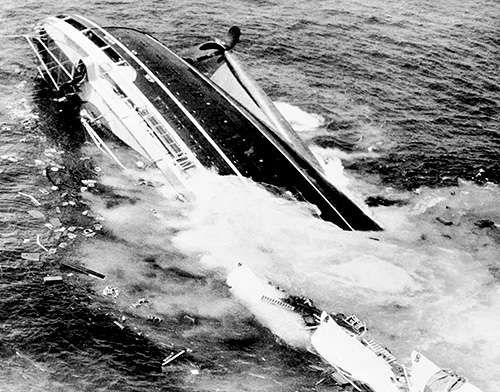
Photo Credit:Harry Trask, 1956
5) They had plenty of assistance and relatively few lives were lost.
Not only did the lightly battered Stockholm stay to help to the best of their ability, multiple ships responded to Andrea Doria’s distress call.
The other ships diverted their course, or even turning around, to take on Andrea Doria’s passengers and convey them to New York. In the end, five ships were filled with what remained of the passengers and crew.
A huge difference from the Titanic, who didn’t have any help show up for hours, resulting in a much higher death toll than necessary.
The Andrea Doria was the greatest civilian maritime rescue ever witnessed.
While still very tragic, only 46 of the 1,706 passengers and crew of the Andrea Doria died that night. Of those deaths, 44 were from the initial impact (those whose cabins were hit directly).
7) You can SCUBA dive the wreck.
Today, the Andrea Doria lies in 190-240 feet of water.

Photo Credit:Source
So while only the likes of James Cameron gets to use the fancy-pants submarine to go see the Titanic at 12,000 feet deep, highly skilled and advanced SCUBA divers have been visiting the wreck of the Andrea Doria for decades.
However, before you pack up your BCD, please keep in mind that it has been referred to as the “Mt. Everest of Shipwreck diving.” This is due to the strong currents, depth, and the fact that it would be a long way to any medical facilities should the need arise.
The Andrea Doria was the last great ship lost during the golden era of transatlantic passenger ocean liners.
Unlike the Titanic, the Andrea Doria is not a tale of excessive and avoidable lost lives. Thanks to 44 years of advancement in protocol and technology (not to mention plenty of help and a little luck).
Read more from our sources here, here, here, and here.
This article also used “An Objective Forensic Analysis of the Collision Between Stockholm and Andrea Doria” by Samuel Halpern as a source. Click here to read the article.


