Activists Take the Fun Out of Everything
By Dr. Susan N. Werkheiser, D.Ed.
Recently, the educational potential of zoos and aquaria has been called into question because of their highly entertaining qualities. However, those in educational circles know that education and entertainment can, and often do, go hand in hand. If educators didn’t tap into “edutainment,” we certainly wouldn’t have the likes of Schoolhouse Rock, Wishbone, Sesame Street, and Bill Nye the Science Guy, all of which are examples of shows that use “entertainment qualities” such as music, dance, and other highly engaging structure to teach core educational subjects such as math, science, and history.
However, nothing can beat the excitement of a visit to a zoo or an aquarium, which can provide an opportunity for children to actually experience the science of biology, develop the love of animals, and learn environmental conservation all while enhancing cognitive abilities and reasoning skills in an interactive and engaging environment.
Constructivist learning theory argues that children produce knowledge by interacting with their own personal context. The interaction between a child’s experiences and their ideas creates a meaning all their own. There have been many noted developmental psychologists who have expressed the value of learners taking an active role in their own learning. For example, Jean Piaget introduced the notion of children gaining knowledge from their experiences, while Lev Vygotsky presented the social aspect of constructivism emphasizing the critical nature of the learner being actively involved in creating knowledge.
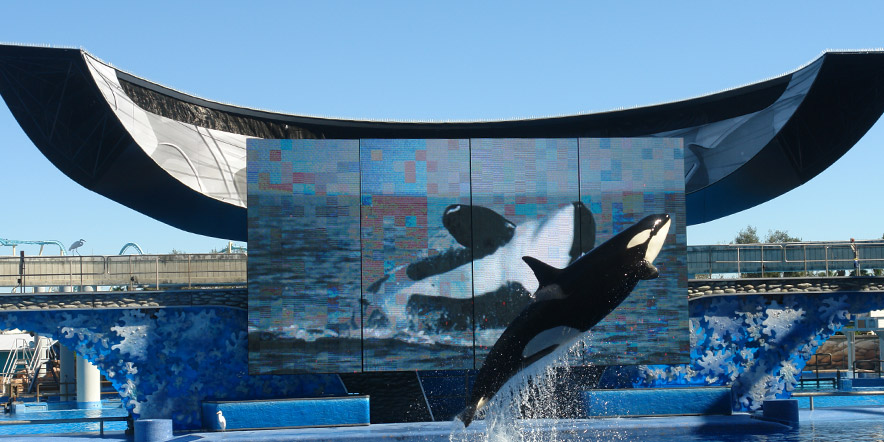
In addition to the cognitive benefits children gain from attending programs and animal displays at places such as SeaWorld, Price and Hein (1991, p. 510) describe programs that are “educationally effective” as those that “spark inquiry, where open-ended questions are generated, and students actively participate and are involved”. The colorful displays, entertaining shows, and hands-on programs are accompanied by information that visitors will retain well after their visit certainly makes these types of places seem like they make an educational impact for a majority of the visitors (Falk, et al. 2007).
Science learning, and a better understanding of both land and ocean animals and their habitats, can’t be gained without zoos and aquaria. Studies showing that conservation knowledge, positive attitude and behavior changes, and a greater appreciation towards the world’s creatures can be facilitated by visits to zoos and aquaria (Kruse & Card, 2004; Wagoner & Jensen, 2010). Hands-on can be fun and educational at the same time. Fun is what makes the experience long-lasting.
References
Falk, J. , Reinhard, E., Vernon, C., Bronnenkant, K., Deans, N. , & Heimlich, J.(2007). Why zoos & aquariums matter: Assessing the impact of a visit to a zoo or aquarium. Silver Spring, MD: Association of Zoos & Aquariums.
Kruse, C. & Card, J. (2004). Effects of a conservation education camp program on campers’ self-reported knowledge, attitude, and behavior. The Journal of Environmental Education, 35(4), 33-45.
Liu, C. & Matthews, R. (2005). Vygotsky’s philosophy: Constructivism and its criticisms examined. International Education Journal, 2005, 6(3), 386-399.
Piaget, J. (1957). Construction of reality in the child. London: Routledge & Kegan Paul.
Price, S., & Hein, G. E. (1991). More than a field trip: Science programs for elementary school
groups at museums. International Journal of Science Education, 13, 505-519.
Wagoner, B. & Jensen, E. (2010). Science
learning
at
the
zoo:
Evaluating
children’s developing
understanding
of
animals
and
their
habitats. Psychology
&
Society, 3(1), 65‐76.