
When Wildlife Documentaries Lose Sight
Image Credit: BBC
We’ve written about wildlife documentaries before, but we wanted to share a word to the wise:
Don’t believe everything you see.
We took an in-depth look at this summer’s Shark Week earlier this year and shared our serious doubts that Discovery Channel had its viewers best educational interests at heart. They have aired specials about everything from Megalodons, mythical monster sharks, and even mermaids.
You can’t blame us for being cynical.
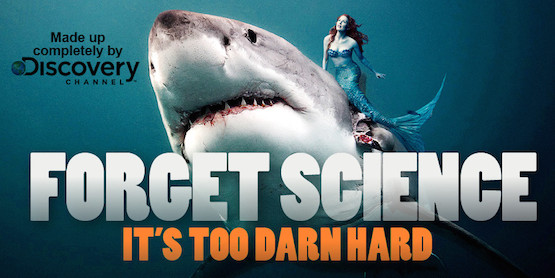
But the line between real, educational documentaries and “mockumentaries” or “docufiction” has gotten increasingly blurrier.
Even some honest filmmakers have stretched the truth on video for the sake of a point of view or project.
For example, even a reputable wildlife documentarian like Chris Palmer has crossed that line.
During the filming of the IMAX documentary, Wolves, Palmer admits he slipped up.
“While the audience thought they were watching wild, free-roaming wolves, in fact we rented them,” Palmer explained. “We rented them from a game farm.”
Because the filmmakers wanted to show the complex social life, they needed a captive pack. Wild wolves are skittish and might have run away when they heard a camera or film crew.
Palmer says the mistake they made was not using a captive pack, but not telling the audience they were using a captive pack.
After a screening, an audience member excitedly asked how he got a shot of one of the mother wolves in a den.

“We made that den – it’s an artificial den for that wolf. And I could tell when I told them, I could feel the disappointment in the air,” Palmer says. “And that was one of the things that came to haunt me.”
The deceptions continue.
One technique is to edit the shot so that prey and predator appear closer together. Some directors also “crowd or harass animals” to get the shot they want.
Some directors go a little further, pulling scientists into the mix and not practicing full-disclosure. Jonathan Davis, a shark biologist, was researching bull sharks at the University of New Orleans when a film crew reached out to him.
He didn’t know the interview was for a “documentary” called Voodoo Sharks, and the film crew didn’t tell him.
The interview lasted 3 hours and focused on science and his research, but that didn’t matter. The documentary airs an edited version of Davis’ remarks and makes it sound like he said the “Voodoo shark” might be real.
Davis wasn’t the only scientist interviewed for hours and had his words minced and edited into oblivion – Mark Simmons experienced the same thing when he was interviewed for the mockumentary Blackfish.
Check this video out:
The lesson here is to question what you see. Do your own research, don’t blindly follow the pack.
The pack might love a film about mermaids living among us, after all.

