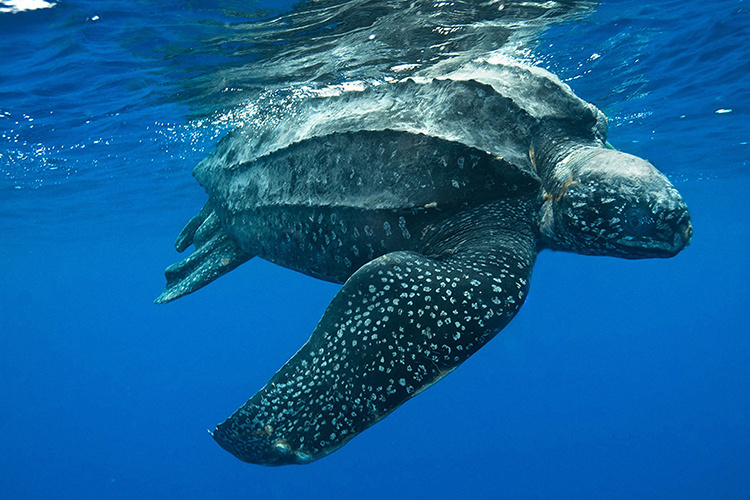
Leatherback Sea Turtles Aren’t Actually Protected by a Hard Shell
When most people picture a sea turtle, the shell is probably the first thing that comes to mind.
Hard. Scaly. Protective.
Then there’s the leatherback.
The largest sea turtle on Earth breaks one of the most familiar rules of being a turtle. Instead of carrying the hard, bony shell seen on green, loggerhead and hawksbill sea turtles, a leatherback’s back is covered by thick, rubbery skin stretched over a flexible structure of small bones.
It’s where the animal gets its name.
Run your hand across one, if you were a permitted researcher handling the animal, and it wouldn’t feel like the shell most people associate with a turtle. It would feel more leathery.
That unusual body is part of what makes the leatherback one of the most extraordinary reptiles in the ocean.
Adult leatherbacks can reach more than six feet in length and weigh well over 1,000 pounds. The largest individuals can become even heavier.
But despite their enormous size, leatherbacks aren’t lumbering coastal turtles.
They’re ocean travelers.
Leatherbacks regularly cross enormous stretches of open water, moving between tropical nesting beaches and feeding grounds that can extend into much colder regions. NOAA says individuals can migrate more than 10,000 miles each year between nesting and foraging areas.
That’s an astonishing journey for any animal.
For a reptile, it gets even stranger.
A Sea Turtle Built for the Open Ocean
Leatherbacks can venture into waters far colder than those used by most reptiles.
They accomplish that through a collection of adaptations that help them retain heat, including their large body size, insulating layers of fat and specialized circulation.
Their bodies can remain warmer than the surrounding water, allowing leatherbacks to pursue prey into environments that would be difficult for many other reptiles to tolerate.
And what does a turtle weighing hundreds of pounds travel all that distance to eat?
Mostly soft, squishy animals.
Leatherbacks specialize heavily in jellyfish and other gelatinous prey.
Their mouths are adapted accordingly.
Instead of teeth, the mouth and throat contain backward-pointing structures called papillae. These help grip slippery prey and move it toward the digestive system.
If you’ve ever seen a photograph looking directly into a leatherback’s mouth, the result can be startling. Rows of pointed papillae make the inside look almost prehistoric.
They’re not teeth.
They’re essentially part of a conveyor system for jellyfish.
Leatherbacks are also exceptional divers.
NOAA reports that they can dive to depths approaching 4,000 feet, allowing them to follow prey far below the surface.
Even their shell, or more accurately their carapace, appears suited to this lifestyle.
Instead of a rigid shell covered in hard scutes, a leatherback has seven prominent ridges running lengthwise along its back. Its more flexible construction creates a streamlined shape for moving through open water and may help the animal withstand pressure during deep dives.
It’s a radically different approach from the turtle body most of us recognize.
Unfortunately, being perfectly adapted for eating jellyfish can also create a dangerous problem in an ocean filled with trash.
Floating plastic bags and other debris can resemble gelatinous prey. Leatherbacks may swallow plastic accidentally, potentially causing injuries or interfering with digestion.
Fishing gear is another major threat. Because leatherbacks travel enormous distances across international waters, they can encounter fisheries and other human activity throughout their migrations.
That makes protecting them particularly complicated.
A leatherback that nests on a beach in one country might travel thousands of miles through the waters of several others before returning.
Its life doesn’t fit neatly inside lines drawn on a map.
Neither does its biology fit neatly into what most people expect from a turtle.
It can weigh more than half a ton.
It can cross entire ocean basins.
It can dive thousands of feet beneath the surface.
It can venture into surprisingly cold water.
And underneath that famous black, ridged back, there isn’t a traditional hard turtle shell at all.
After more than 100 million years of sea turtle evolution, leatherbacks have ended up with a body unlike any other sea turtle alive today.
Sometimes breaking the rules works.
Sources : NOAA Fisheries