Octopuses Have Three Hearts, Blue Blood and Bodies Unlike Almost Anything Else in the Ocean
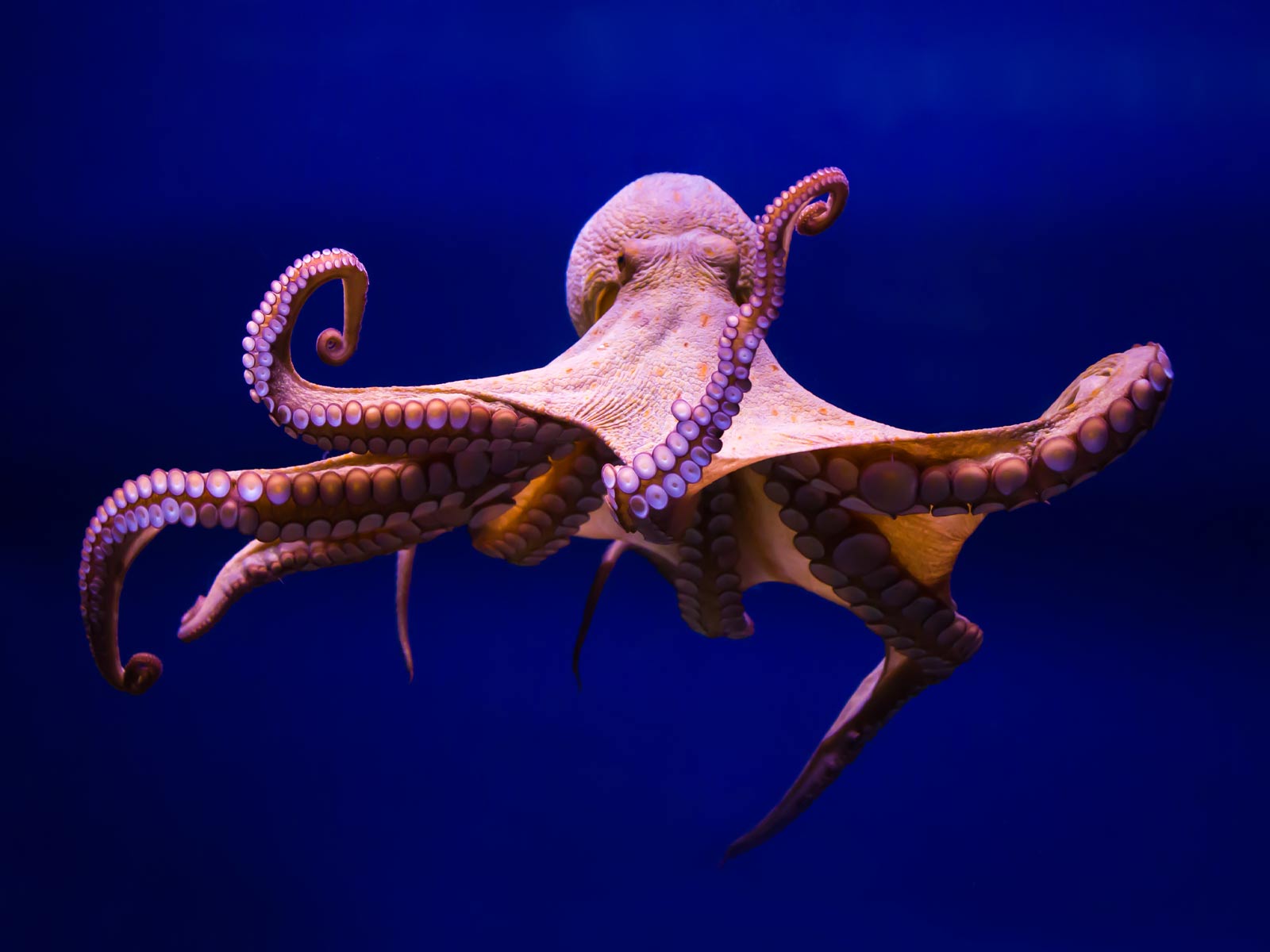
An octopus already looks like an animal designed by someone who ignored most of the normal rules.
Eight arms. No bones. Thousands of suckers. The ability to squeeze through ridiculously small spaces and disappear against a rock almost instantly.
But things get even stranger inside.
Octopuses have three hearts.
Their blood is blue.
Their brain is shaped like a ring around their esophagus.
And much of the information they collect about the world comes through arms covered with suckers that can both touch and chemically sense their surroundings.
Even by ocean standards, octopus anatomy is weird.
The three-heart situation starts with the way an octopus breathes.
Two of its hearts, known as branchial hearts, are responsible for pumping blood through the gills, where it picks up oxygen. A third heart, called the systemic heart, then pumps that oxygenated blood throughout the rest of the animal’s body.
Humans accomplish circulation with one four-chambered heart.
Octopuses took a different route.
Then there’s the blood itself.
If you could see oxygenated octopus blood, you wouldn’t find the familiar red we associate with our own.
You’d see blue.
That’s because humans use an iron-containing protein called hemoglobin to transport oxygen through the bloodstream. Octopuses and other cephalopods instead rely on hemocyanin, which contains copper.
That copper gives their blood its distinctive blue appearance.
It’s an adaptation that works particularly well for animals living in cold marine environments, although researchers continue to study exactly how cephalopod circulation responds to different temperatures, oxygen levels and ocean conditions.
But three hearts and blue blood are only the beginning.
An Octopus Experiences the World Through Its Arms
An octopus sucker is much more sophisticated than a tiny suction cup.
The suckers contain enormous numbers of sensory receptors that allow an octopus to gather information about whatever its arms are exploring.
That includes chemical information.
In simple terms, an octopus can effectively “taste” what it touches.
That ability makes a lot of sense when you consider how an octopus hunts.
An octopus may crawl across rocks and the seafloor, pushing its arms into cracks and crevices while searching for crabs, shrimp, clams and other prey.
It doesn’t have to rely entirely on eyesight to determine what’s hiding inside.
Its arms are collecting information as they explore.
Then there’s the brain.
In cephalopods, the central brain sits behind the eyes and wraps around the esophagus in a ring-like shape. That means food traveling from the mouth toward the digestive system actually passes through the middle of that ring.
Yes, an octopus essentially eats through the center of its brain.
And because an octopus doesn’t have a skeleton, it can take advantage of spaces that would be impossible for most animals its size to enter.
The main limitation is its beak.
If the hard beak can fit through an opening, much of the rest of the octopus may be able to follow.
For an animal without a protective shell, all of these unusual adaptations are extremely useful.
Modern octopuses are mollusks, making them relatives of animals such as clams and snails. But unlike many of their mollusk relatives, they don’t walk around carrying a hard external shell for protection.
Instead, they rely on a spectacular collection of other defenses.
Their skin contains thousands of specialized pigment structures called chromatophores. By controlling them, an octopus can rapidly alter its appearance.
And color isn’t the only thing that can change.
Some species can alter the texture of their skin, creating bumps, ridges and projections that help their bodies resemble rocks, coral or algae.
If camouflage fails, there’s always another option.
Leave.
An octopus can force water through a muscular structure called a siphon, propelling itself away from danger. Many species can also release a cloud of ink that helps obscure a predator’s view and gives the octopus another opportunity to escape.
Put everything together and you get one of the strangest body plans in the animal kingdom.
Three hearts keep the blood moving.
Copper helps carry oxygen through that blue blood.
Thousands of suckers allow the animal to explore its surroundings.
A soft body lets it squeeze into tiny spaces.
And skin capable of changing color and texture can make the entire animal seem to disappear.
An octopus might look like an alien.
Once you learn what’s happening inside, it somehow gets even weirder.
Sources: Monterey Bay Aquarium , Smithsonian Ocean