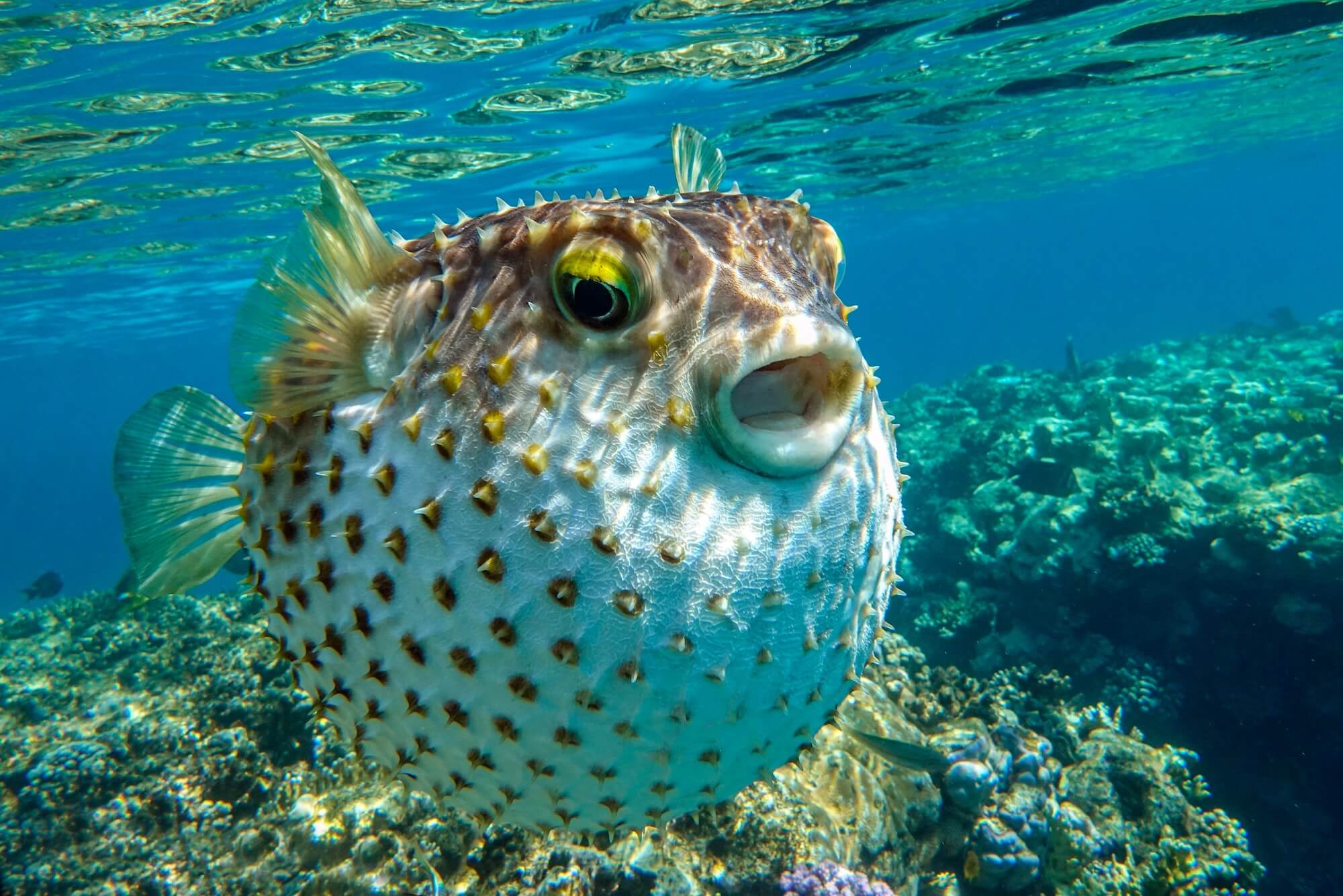
Pufferfish Don’t Fill Themselves With Air and the Real Way They Inflate Is Even Stranger
Few fish have a more recognizable defense strategy than the pufferfish.
One moment, it’s a relatively ordinary-looking fish swimming around a reef. The next, it’s a giant round ball that suddenly looks considerably harder to swallow.
But there’s a common misconception about what’s actually happening.
Pufferfish aren’t normally blowing themselves up with air.
They’re filling themselves with water.
When a pufferfish feels threatened, it can rapidly gulp water into a highly expandable portion of its digestive system. As water rushes in, the fish’s body expands dramatically, transforming it from an easy-looking meal into something much larger and considerably more difficult for a predator to swallow.
Some species add another layer to the defense.
Spines that aren’t particularly intimidating when the fish is relaxed become much more noticeable as the body expands.
Suddenly, the predator isn’t dealing with a small fish anymore.
It’s dealing with a giant, potentially spiky ball.
That’s especially useful because pufferfish aren’t exactly built to win many underwater races.
Their relatively slow and sometimes awkward swimming style means simply outrunning a predator isn’t always an option. Instead, evolution gave them another solution.
If you can’t get away from something trying to eat you, make yourself extremely difficult to eat.
And if that doesn’t work, some pufferfish have another nasty surprise waiting.
Some Pufferfish Are Incredibly Toxic
Many pufferfish contain tetrodotoxin, a powerful neurotoxin that interferes with the nervous system.
The toxin can be concentrated in organs such as the liver and reproductive organs, though toxicity varies considerably between species and individuals.
Tetrodotoxin works by blocking sodium channels that nerve and muscle cells rely on to transmit electrical signals.
In serious human poisonings, that can cause paralysis and respiratory failure.
There is no specific antidote.
It’s an extraordinary defense system for an animal that doesn’t necessarily produce all of the toxin entirely on its own.
Evidence suggests that at least some pufferfish acquire tetrodotoxin through their diet and relationships with toxin-producing microorganisms. That helps explain why toxicity can vary depending on species, habitat and what an individual animal has been eating.
Then there are the teeth.
Pufferfish belong to the family Tetraodontidae, a name that refers to their distinctive dental arrangement.
Their teeth are fused into four hard plates that form something resembling a beak.
And they need it.
Many pufferfish eat hard-shelled animals such as mollusks and crustaceans, so having a powerful set of dental plates allows them to crush food that would be difficult for many other fish to handle.
Those teeth continue growing, with normal feeding helping wear them down.
Put all of those adaptations together and the pufferfish starts looking less like a goofy balloon and more like an animal that’s remarkably well equipped for survival.
It has a powerful beak for feeding.
Many species carry a potentially deadly chemical defense.
Some have spines.
And if a predator still decides to take its chances, the fish can suddenly become several times more difficult to fit inside a mouth.
There’s even considerable diversity hiding behind the name “pufferfish.”
Pufferfishes belong to a much larger group called the Tetraodontiformes, which includes animals such as triggerfish, filefish, boxfish and the enormous ocean sunfish.
Pufferfish themselves are found across tropical and subtropical waters around the world, although some species live in brackish or freshwater environments.
They come in different sizes, colors and patterns.
But inflation remains their signature move.
It’s important to remember that puffing up isn’t something the fish does for fun.
Inflation is an emergency response.
The animal is essentially deploying one of its major defenses because it believes something might be trying to eat it. That’s why deliberately frightening or handling a pufferfish simply to watch it inflate isn’t harmless entertainment.
For the pufferfish, the entire point is survival.
And it’s an impressive strategy.
A relatively slow fish didn’t evolve incredible speed to escape its predators.
Instead, it evolved the ability to completely change its shape.
When danger arrives, the pufferfish takes in water, expands its body and turns itself into a meal that suddenly looks like far more trouble than it’s worth.
Sometimes the best way to avoid being eaten isn’t running away.
It’s making your predator reconsider the menu.