
PUH-lease, You Don’t Know These 7 Penguin Facts…
Featured Image Credit: ens-newswire.com
By Eva Gruber
Everyone knows and loves penguins, one of the most beloved marine animals on the planet. Found exclusively in frigid cold waters of the Southern Hemisphere, they rely on productive marine ecosystems. Having lost the ability to fly unlike most other birds, instead they “fly” through the water, driven by powerful strokes from their flippers. Here are some of the best penguin facts you may not be aware of!
- There are 17 recognized species of penguin, all of them residing in the Southern Hemisphere. Some of the better known penguin species are the largest – the emperor penguin, and its similar-looking cousin, the king penguin. There is also the classic and abundant tuxedo-wearing Adelie penguin. But there is also the lesser-known Snares penguin, which is limited to the 341-hectare large Snare Island off the coast of New Zealand. Galapagos penguins are also oft-forgotten, and yet they are incredibly unique in being the penguin found the furthest north – in some places even technically north of the Equator.

Image Credit: wallpaperscraft.com
- Penguin feathers are highly evolved structures. Unlike any other bird feathers, penguin feathers are unique in structure and in function. Instead of being evolved for warmth and fluff, penguin feathers are all about increasing the hydrodynamics of the bird in the water. Stiff and small, penguin feathers overlap each other much like fish scales, and are densely packed in to create a waterproof barrier to keep the bird dry and warm in the frigid water and air. Additional waterproofing of the feathers is achieved through preening, where the bird spreads natural oils secreted by the uropygial gland above the base of the tail.

Image Credit: photovolcanica.com
- The second physiological adaptation that enables penguins to survive in below-freezing temperatures is a thick layer of blubber beneath the skin. Up to 30% of the weight of a penguin can be blubber. This layer of fat is several centimeters thick, and is crucial to the animal’s survival. Blubber not only increases insulation against the cold, but also is a source of energy for the animal, and provides buoyancy in the water.

Image Credit: factzoo.com
- The most abundant penguin species? The macaroni penguin with an estimated 11,645,000 breeding pairs. The species with the lowest population is the endangered Galapagos penguin, with only around 1,500 breeding pairs. These pairs are all that’s left from a drastic population crash in the 1980s caused by lack of fish to eat (in turn caused by overfishing by humans).
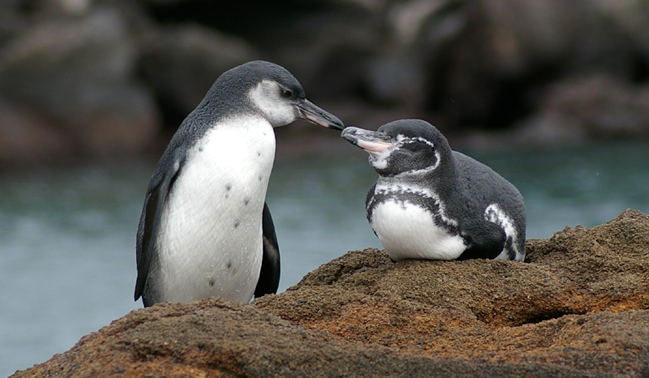
Image Credit: galapagos.org
- Monogamy may not be the best term for penguin couples. While it is true that individual birds will relocate and pair up with their mate for years, even decades, the birds often engage in extra-pair copulations – sometimes in exchange for food, or rocks to build up the nest. This is in fact beneficial to the population, as it increases the genetic diversity of the offspring. They will continue to raise chicks together regardless of who the real penguin father is.

Image Credit: John Downer Productions
- Penguins will swallow small rocks and pebbles along with their food – on purpose. It is thought that this behavior is beneficial for a couple of reasons. Since all birds lack teeth, rocks in the stomach may help break up food matter and increase digestion and absorption of nutrients. Penguins may also benefit from the added weight of rocks, which would act as ballasts and help them dive deeper underwater.

Image Credit: National Geographic
- Penguins are truly marine animals – they spend up to 75% of their lives in the water. They make their living in the water – hunting and feeding on a variety of fish, squid, and krill species. They are highly adapted animals, evolved to survive and thrive in their marine environment. From their specialized anatomy to their unique physiology, penguins are the most ultimate marine bird.

