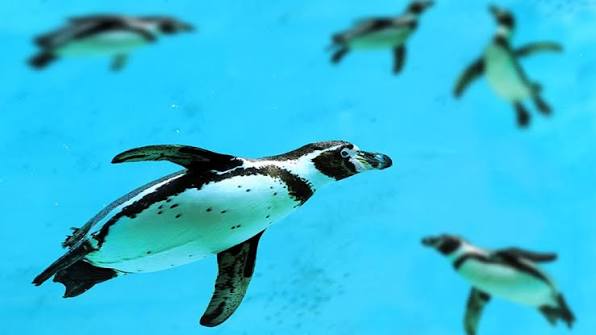
Penguins May Look Awkward on Land but Their Entire Bodies Are Built for Life in the Ocean
On land, penguins aren’t exactly graceful.
They waddle. They stumble. Sometimes they give up on walking altogether and slide across the ice on their bellies.
Then they hit the water.
Almost instantly, the awkward little bird disappears and something completely different takes its place.
Penguins are extraordinarily capable marine predators whose bodies have been reshaped by evolution for life underwater. Their wings have become powerful flippers, their bones help them dive and even their famous black-and-white tuxedos serve a purpose once they leave shore.
Penguins can’t fly through the air.
They essentially fly through the ocean instead.
Their wings are shorter, flatter and much stiffer than the wings of flying birds. Rather than producing lift in the air, they generate thrust underwater, allowing a penguin to propel itself forward while its feet and tail help with steering.
Their bodies have also taken on a streamlined, torpedo-like shape that allows them to move efficiently through the water.
Even their bones are different.
Flying birds benefit from lightweight skeletons. Penguins don’t need to become airborne, and their heavier, denser bones can actually help them overcome buoyancy and dive beneath the surface.
For species that spend much of their lives chasing fish, squid and krill underwater, losing the ability to fly wasn’t necessarily a bad trade.
They simply became better at flying somewhere else.
Even the Tuxedo Has a Job
Penguins are so closely associated with their black-and-white appearance that it’s easy to assume the coloring is just another charming part of being a penguin.
It may actually help them survive.
The pattern is known as countershading.
Imagine looking down at a swimming penguin from above. Its dark back can be harder to distinguish against the darker ocean below.
Now imagine looking up at the same penguin from underneath. Its white belly can blend more closely with the brighter water and sunlight above.
That camouflage can make the penguin more difficult for predators to spot, while potentially making it harder for prey to see the penguin coming.
Then there are the feathers.
Penguins have extremely dense, overlapping feathers that create a protective barrier against water and cold. They spend considerable amounts of time preening, carefully maintaining those feathers and spreading oil produced by a gland near the base of the tail.
That maintenance is critical.
A penguin isn’t simply wearing a layer of feathers. It’s maintaining a remarkably effective insulating system that helps keep cold water away from its skin and traps air within its plumage.
Some penguins take the system to extremes.
Emperor penguins can dive beyond 500 meters, or more than 1,600 feet, beneath the ocean’s surface. During deep dives, they can slow their heart rate and reduce blood flow to less essential parts of the body, conserving oxygen for organs that need it most.
They also have to deal with another problem that comes with spending so much time in the ocean.
Salt.
Penguins swallow seawater while hunting and can even drink it, but too much salt would create serious problems for their bodies.
So they have their own desalination system.
Specialized salt glands located above their eyes remove excess salt from the bloodstream. The concentrated salty fluid travels toward the bill, where it can drip out around the nostrils before being shaken away.
It can sometimes look like a penguin has a runny nose.
In reality, its body is getting rid of ocean salt.
Even a penguin’s mouth is designed for catching slippery prey.
Penguins don’t have teeth. Instead, their mouths contain backward-pointing structures that help grip fish and other slippery animals and guide them toward the throat.
Once a penguin catches something, getting back out isn’t easy.
All of these adaptations make the difference between watching a penguin on land and watching one underwater even more remarkable.
The same animal that can look like it’s struggling to navigate a patch of rocks can suddenly become a fast, agile predator the moment it dives beneath the surface.
That’s because penguins aren’t poorly designed birds that forgot how to fly.
They’re incredibly specialized seabirds that traded the sky for the ocean.
The waddle is just what happens when they come back ashore.
Sources: