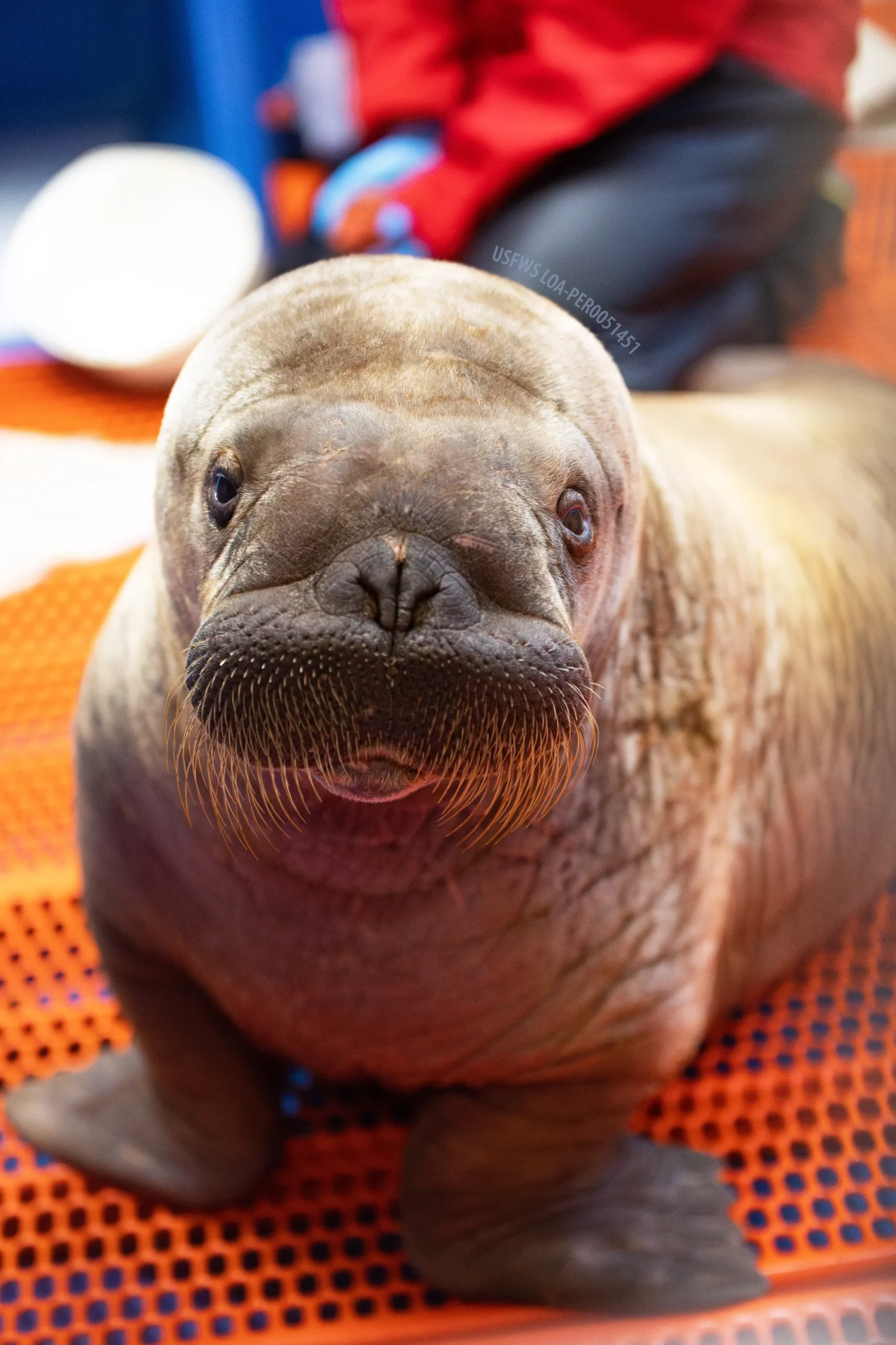
An Orphaned Walrus Calf Was Found Hiding Between Two Dead Adults in Alaska. Now He’s Growing Up at SeaWorld Orlando.
A walrus herd on a remote beach in northern Alaska left the shore during heavy surf. One calf didn’t make it into the water with them.
When Violet Anniskett, a wildlife research intern from the local community, and Tony Fischbach, a U.S. Geological Survey scientist, found him, the young male was hiding between the remains of two dead adult walruses. Scavenging birds were already targeting him. He was about five months old. Pacific walrus calves depend entirely on their mothers’ milk for their first year, and on their mothers for protection and for learning how to survive. On his own, the calf had little chance.
Anniskett and Fischbach cared for him for several days. With help from the local community and federal wildlife officials, he was then flown to the Alaska SeaLife Center in Seward.
Anniskett named him Annautaq, pronounced “ah-now-tuq.” It means “axe” in Iñupiaq, and it was her father’s Iñupiaq name.
Round-the-Clock Care
At the SeaLife Center, the wildlife response team stabilized the calf and met his medical and social needs around the clock. SeaWorld sent animal care and veterinary specialists with walrus experience to Alaska to help with his intensive care and prepare him for what came next.
“Annautaq’s story shows why having specialized marine mammal rehabilitation capacity in Alaska is so important,” said Jane Belovarac, the Alaska SeaLife Center’s wildlife response curator.
The U.S. Fish and Wildlife Service, which oversees walruses in the United States, determined that Annautaq could not be returned to the wild. Without a mother to nurse him and teach him, a calf his age cannot survive in the Arctic. Experts from across the walrus care community then had to decide where he would spend his life. They chose SeaWorld Orlando, based on his long-term care and social needs, including the chance to grow up with other walruses.
A 4,000-Mile Journey
Few places in the country can offer that. SeaWorld Orlando is one of only four institutions in the United States currently able to house walruses.
Annautaq now weighs about 220 pounds and is in a planned 30-day quarantine with 24-hour support. He gets up to six bottle feedings a day of a high-fat formula that SeaWorld’s veterinary and animal care teams developed to match the richness of walrus milk.
“At this young age, Annautaq needs more than nutrition and veterinary care,” said Jim Kinsler, a curator at SeaWorld Orlando. A walrus calf learns how to be a walrus from other walruses.
A Herd That Knows the Way
The herd waiting for him has been through this before. Kaboodle, 23, is an experienced mother and a proven surrogate for rescued calves. One of those calves was Uki, now a two-year-old female who was also rescued in Alaska and rehabilitated at the Alaska SeaLife Center before coming to Orlando. Uki has bonded closely with Kaboodle. Garfield, 44, was himself an orphaned calf from Alaska, hand-raised at SeaWorld Orlando more than four decades ago.
Introductions will happen at Annautaq’s pace. The animal care team will decide when he is ready to meet the herd and when guests can see him in the park’s Expedition Odyssey habitat.
Why It Matters
Pacific walruses are under growing pressure as Arctic sea ice retreats. Walruses use the ice as a floating platform to rest and nurse calves near their feeding grounds. With less ice, more of them crowd onto beaches, where stampedes and storms can separate or crush calves. Rescues like Annautaq’s depend on a chain of people that starts with whoever finds the animal. In this case it ran from a local intern and a federal scientist to a rehabilitation center in Seward and a park in Florida.
Sources: SeaWorld Orlando, Alaska SeaLife Center, Amusement Today, Parade, New York Post.