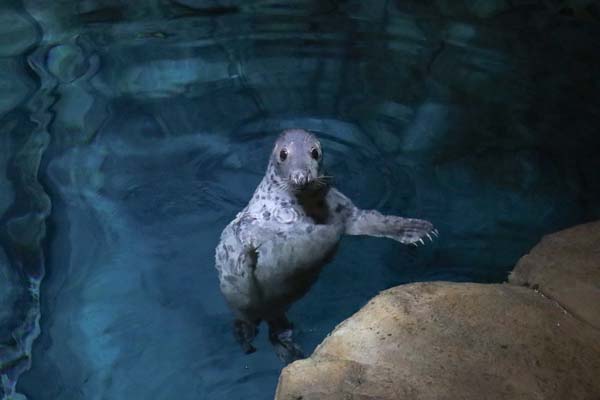
A Young Seal Was Rescued Twice and Now She Has a New Home Built Around Her Second Chance
Pearl has already been given two chances to return to the ocean.
Now she’s getting a different kind of second chance.
The young gray seal recently arrived at the Maritime Aquarium at Norwalk in Connecticut after a remarkable journey that included two separate rescues, months of rehabilitation and the discovery of a spinal condition that ultimately made returning to the wild too dangerous.
Pearl is estimated to be around 2 years old.
Her story began in January 2025, when she stranded as a pup in Rhode Island.
She was rescued and brought to Mystic Aquarium, where rehabilitation specialists cared for her until she was healthy enough to return to the ocean.
For a rescued marine animal, that’s usually the ending everyone hopes for.
Pearl was released.
But her story wasn’t finished.
She later stranded again, this time in Montauk, New York.
Pearl was brought into care for a second time, with the New York Marine Rescue Center taking over her rehabilitation.
During that process, specialists discovered something that would change her future.
Pearl has a spinal deformity that has left her right rear flipper paralyzed.
For a wild seal, that’s a serious problem.
Gray seals spend much of their lives at sea, where swimming efficiently, finding food, navigating currents and avoiding danger are essential to survival. Although Pearl had already proven remarkably resilient, wildlife officials ultimately had to decide whether sending her back into the Atlantic for a second time was really in her best interest.
NOAA determined it wasn’t.
Pearl was deemed non-releasable.
That meant she needed a permanent home.
Finding Pearl Somewhere She Could Thrive
When a rescued marine mammal cannot safely return to the wild, rehabilitation centers don’t simply keep the animal indefinitely.
Officials work to find a zoological facility capable of meeting that individual animal’s medical, behavioral and social needs.
In Pearl’s case, that search led to the Maritime Aquarium at Norwalk.
The aquarium already cares for seals and has the specialized staff and habitat needed to support an animal with Pearl’s condition.
But her transition didn’t begin the day she arrived.
Members of the Maritime Aquarium’s animal husbandry team traveled regularly to Pearl’s rehabilitation facility before the move, allowing them to begin establishing care routines and building familiarity with her.
That preparation matters.
For an animal that has already experienced multiple strandings, rehabilitation and transportation, another major change can be significant.
The goal was to make Pearl’s next move her last.
After arriving in Norwalk, she completed a quarantine and acclimation period before being introduced to the aquarium’s other seals.
She has now joined Gracie, Sono, Mikey and Kaya at Pinniped Cove.
And she’s making a little history in the process.
Pearl is the Maritime Aquarium’s first female gray seal.
Visitors can distinguish her from the others by the dark spots scattered across her silver-gray fur.
Her disability also makes her different.
Because her right rear flipper is paralyzed, Pearl relies heavily on her front flippers when swimming. Aquarium staff expect that her spinal condition could also result in her remaining smaller than a typical adult female gray seal.
That doesn’t mean she can’t have a full life.
It means her care has to be designed around the animal she actually is.
The aquarium’s husbandry team is continuing to monitor Pearl as she settles into her new environment while working with her on foundational behaviors.
Those behaviors aren’t just tricks.
Modern animal training at accredited aquariums can allow seals and other marine mammals to voluntarily participate in their own medical care. Animals can learn to position different parts of their bodies for examinations, step onto scales, allow veterinarians to inspect them and cooperate with other routine procedures.
For an animal with a lifelong spinal condition, that kind of participation could become especially valuable.
Pearl’s story also illustrates a side of marine animal rescue that doesn’t always receive as much attention.
Release is usually the goal.
Sometimes it isn’t possible.
An animal can survive the injury or illness that originally brought it into rehabilitation and still be left with a condition that makes surviving independently in the wild unlikely.
That’s when aquariums and other accredited zoological institutions can become the final piece of the rescue network.
They provide somewhere for animals like Pearl to go.
Instead of facing another release that wildlife officials determined she was unlikely to survive, Pearl now has professional veterinary care, a habitat designed for seals and a social group around her.
Her life probably isn’t going to look like the one rescuers imagined when she first washed ashore as a pup in Rhode Island.
Back then, the goal was simple.
Get her healthy and send her home.
They did.
When Pearl needed help again, rescuers changed the plan.
Sometimes successful wildlife rescue means watching an animal disappear back into the ocean.
Sometimes it means recognizing when it shouldn’t.
For Pearl, her second rescue didn’t end with another release.
It ended with a new home.