Four Seals Got Trapped Inside a Massive Dry Dock and Rescuers Had to Get Creative to Save Them
For a group of Cape fur seals in South Africa, what probably looked like an all-you-can-eat buffet nearly turned into a trap.
The seals had discovered a huge school of mullet swimming inside Cape Town’s Sturrock Dry Dock and apparently decided there was no reason to leave.
There was just one problem.
It was a dry dock.
Once the enormous gates closed and the water began disappearing, the seals could be trapped inside with walls rising roughly 45 feet around them.
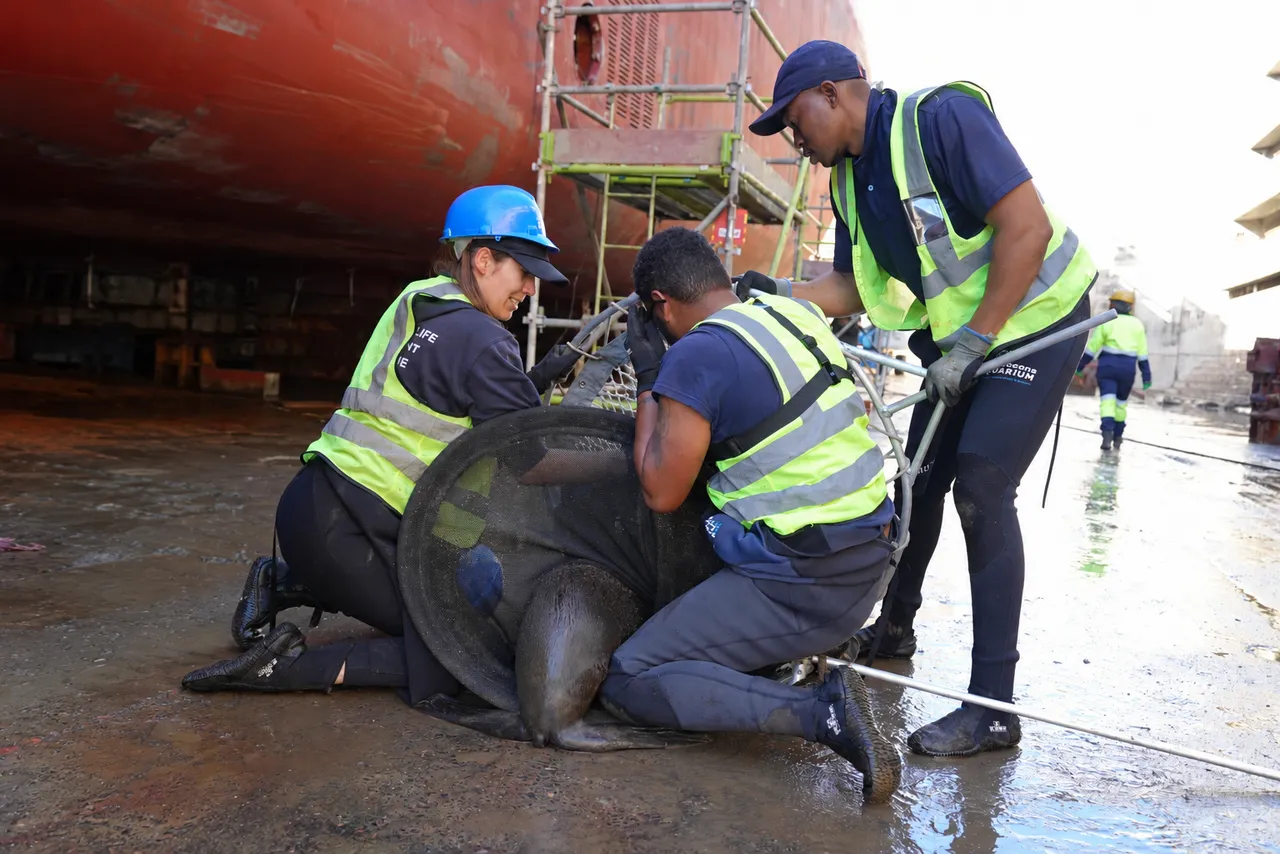
That set off an unusual rescue operation led by the Two Oceans Aquarium Foundation’s Marine Wildlife Management Programme.
The situation began in early August, when the dock master alerted the team that several seals had been spotted swimming inside the flooded dock.
At first, the animals weren’t necessarily in immediate danger. The dock was full of water and, thanks to all those mullet, there was plenty to eat.
But dry docks aren’t designed to remain full.
Ships enter while the dock is flooded, enormous gates close behind them and the water is pumped out so maintenance can be performed on the vessel.
Any marine animal still inside when that happens can suddenly find itself in serious trouble.
For a seal, simply climbing out wasn’t much of an option. The dock’s walls rise about 14 meters above the bottom, and the surrounding infrastructure can make escaping difficult once the water level drops.
Rescuers needed to get the animals out before that happened.
The first attempt sounded simple enough.
Open the gates and encourage the seals to leave.
The seals had other ideas.
With plenty of fish still swimming around inside the dock, they apparently weren’t particularly interested in giving up their temporary feeding ground.
So the rescue team had to get creative.
Getting Four Wild Seals to Cooperate Was the Hard Part
Rescuers began trying to herd the animals toward the dock’s exit using boats.
That didn’t work.
The seals could simply dive beneath the boats and swim back into the dock.
The team then tried creating a barrier using floating booms, slowly reducing the amount of space available and encouraging the animals toward the open gate.
Again, the seals proved difficult to convince.
Eventually, the team determined that the safest option would be to physically capture the animals.
That created another challenge.
These weren’t small animals sitting quietly on a beach waiting for help. Cape fur seals are powerful, fast-swimming marine mammals, and the rescue was happening inside an enormous industrial structure.
The team used specialized nets and worked carefully to capture the seals one at a time.
Each animal was brought under control, assessed and prepared for transport.
Then came the part everyone had been working toward.
Freedom.
The seals were transported away from the dry dock and released back into the ocean.
All four ultimately made it out safely.
It’s the kind of rescue that demonstrates just how unpredictable marine wildlife response can be.
Animals don’t understand that the humans chasing them with boats, barriers and nets are trying to help.
From the seal’s perspective, there was food everywhere and a group of people had suddenly arrived to ruin lunch.
From the rescuers’ perspective, there was a deadline.
If the dock needed to be drained while the animals were still inside, the situation could become far more dangerous.
Dry docks can occasionally trap other marine animals too. The Two Oceans Aquarium Foundation says seals, sunfish and even dolphins can find their way into these enormous structures while they’re flooded.
That means teams operating around busy harbors have to be prepared for some unusual calls.
Marine animal rescue doesn’t always happen on a beach.
Sometimes there’s no injured animal.
Sometimes nothing has become entangled.
And sometimes the entire rescue comes down to recognizing that a perfectly healthy wild animal has wandered into a place that is about to become extremely unsafe.
In this case, four seals followed a school of fish somewhere they shouldn’t have gone.
Getting them in was easy.
Getting them to leave took a rescue team, boats, barriers, specialized equipment and a whole lot of patience.
The seals, presumably, just wanted their mullet.
Sources: Two Oceans aquarium Foundation