Walrus Tusks Are Actually Giant Teeth and They’re Far More Useful Than They Look
It’s difficult to mistake a walrus for anything else.
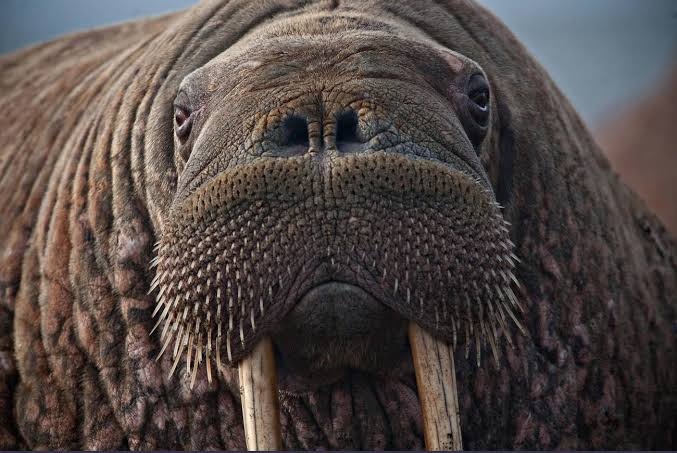
There’s the enormous body, the mustache, the wrinkled skin and, of course, two giant tusks hanging from its mouth.
Those tusks might look like horns, but they’re actually teeth.
Really, really big teeth.
Both male and female walruses grow them. They’re elongated upper canine teeth that can continue growing throughout much of the animal’s life, sometimes reaching around three feet in length.
And walruses have found plenty of uses for them.
Tusks can help establish dominance and are especially important in interactions between males. Bigger animals with larger tusks can have an advantage when competing for social status and access to females.
But fighting isn’t their only purpose.
Walruses can also use their tusks to help pull their enormous bodies out of the water and onto ice.
That’s not a small accomplishment.
Adult male Pacific walruses can weigh more than 3,000 pounds. Moving that much walrus from the ocean onto a slippery chunk of Arctic ice requires some serious leverage.
The tusks can provide it.
It’s one reason the walrus’s scientific name, Odobenus rosmarus, is particularly fitting. Odobenus roughly translates to “tooth-walker.”
They’re not literally strolling around on their tusks, but the name captures just how distinctive those enormous canine teeth are.
And somehow, they aren’t even the walrus’s coolest feeding adaptation.
The Mustache Is Basically a Built-In Food Detector
Look closely at a walrus’s face and you’ll see hundreds of stiff whiskers surrounding its mouth.
They’re called vibrissae.
A walrus can have hundreds of them, and they’re incredibly sensitive.
That’s important because much of a walrus’s food isn’t swimming around where it can easily see it.
It’s buried.
Walruses spend a lot of time feeding along the seafloor, searching for clams and other bottom-dwelling invertebrates.
Visibility down there can be terrible.
Instead of relying entirely on eyesight, the walrus can use its whiskers to investigate the sediment and locate prey by touch.
Once it finds something worth eating, things get even stranger.
Walruses are famous for eating clams, but they don’t necessarily chew through the shells.
They can use their powerful mouths and tongues to create suction, allowing them to pull the soft animal directly out of its shell.
The empty shell gets left behind.
The clam does not.
A large walrus can consume thousands of clams and other small invertebrates during a feeding session.
All of that eating helps support an animal living in one of the harshest environments on Earth.
Walruses inhabit Arctic and sub-Arctic waters where temperatures can be brutal.
Fortunately, they’re carrying their own insulation.
Beneath their thick skin is a substantial layer of blubber that helps retain body heat in frigid water.
That blubber also contributes to their unmistakably massive appearance.
Pacific walruses are the larger of the two recognized subspecies, with adult males sometimes exceeding a ton. Atlantic walruses are generally smaller, though they’re still enormous animals.
Despite their size, walruses are capable swimmers.
Their bodies are built for moving through cold coastal waters, and they can dive to the seafloor while searching for food.
Like other pinnipeds, they can slow their heart rate during dives and direct oxygen toward vital organs.
Eventually, though, they have to come back up.
And walruses spend a surprising amount of time out of the water.
They haul out onto sea ice or land to rest, sometimes gathering in enormous groups.
Historically, floating sea ice has been especially important for Pacific walruses because it gives them a place to rest between feeding trips without having to return all the way to shore.
Females also use ice while caring for calves.
Walrus mothers typically give birth to a single calf, and the bond between them can be remarkably strong.
Calves remain dependent on their mothers for an extended period while learning how to survive in the Arctic environment around them.
Eventually, they’ll develop the same unmistakable features.
The whiskers become more prominent.
The body gets much, much bigger.
And those canine teeth keep growing.
That’s what makes the walrus such a strange combination of adaptations.
The tusks get all the attention, but nearly everything about the animal is specialized for Arctic life.
Its blubber keeps it warm.
Its whiskers help find food it can’t see.
Its mouth can suck a clam straight out of its shell.
Its body can dive into freezing water and return to ice.
And the two enormous teeth hanging from its face can function as weapons, status symbols and tools.
The walrus looks weird because the Arctic demands weird solutions.