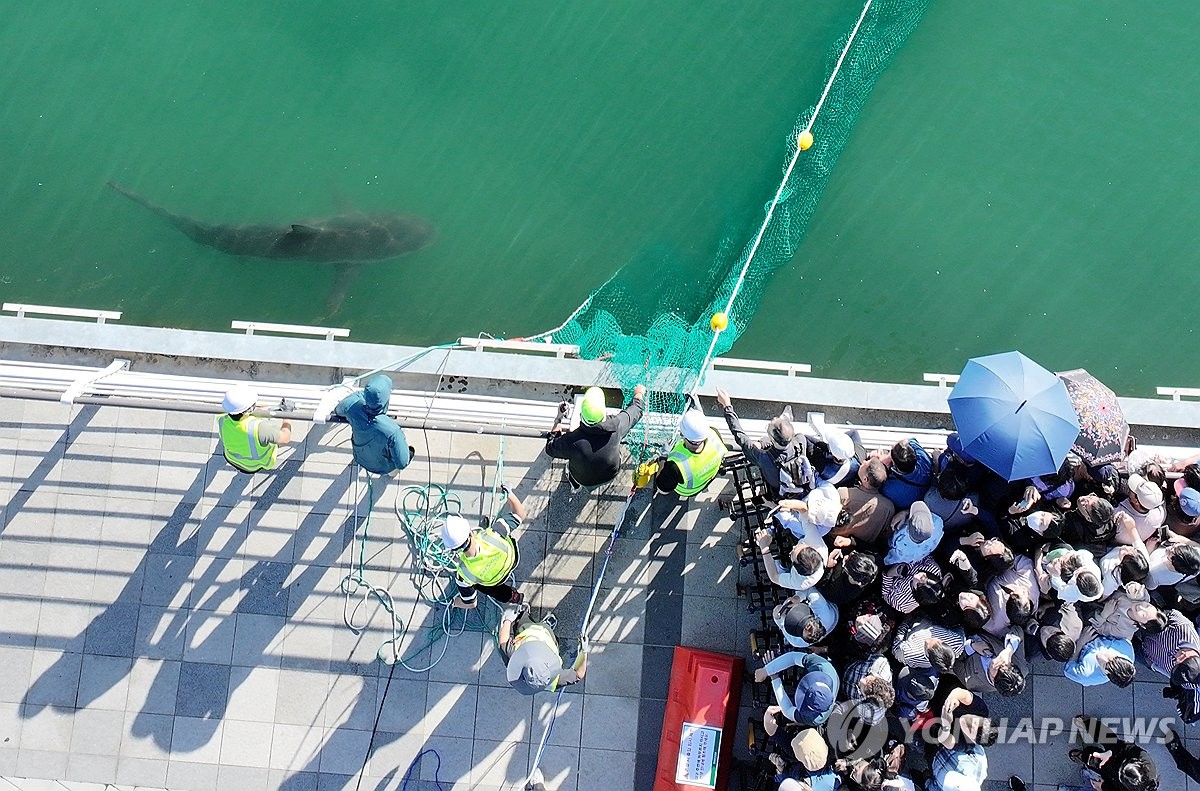
A Shark Trapped in a South Korean Canal Has Become a Local Celebrity as Rescuers Try to Get It Back to the Ocean
For more than two weeks, an unexpected visitor has been swimming through an artificial canal in the middle of South Korea’s second-largest city. The roughly 3.5-meter, or 11.5-foot, shark has attracted enormous crowds, earned itself a nickname and even been named an honorary ambassador for Busan.
There is just one problem: officials would really like it to go back to the ocean.
The shark, nicknamed Bukang-i, was first spotted September 18 in the artificial waterway at Busan’s North Port Waterfront Park. It is believed to be a bronze whaler, a large coastal shark species found in temperate and subtropical waters around the world.
How Bukang-i ended up inside the canal isn’t entirely clear. One possibility is that the shark followed prey into the waterway and then struggled to find its way back out. Whatever brought it there, its extended stay has transformed an unusual wildlife sighting into something approaching a local phenomenon.
By Saturday, more than 700,000 people had visited the waterfront area since the shark first appeared. Crowds have gathered along bridges and walkways hoping to catch a glimpse of its dorsal fin moving through the canal, while photos and videos of the animal have spread widely online.
The public response became so enthusiastic that Busan named Bukang-i an honorary promotional ambassador earlier this week. The nickname itself combines “Bukhang,” the Korean name for North Port, with a Korean suffix commonly attached to names.
Behind the spectacle, however, wildlife officials have been dealing with a much more serious question: how do you convince an 11.5-foot shark to leave a city canal when the shark apparently has other plans?
Two Rescue Attempts and One Very Uncooperative Shark
Authorities initially monitored Bukang-i rather than immediately attempting to remove it, but concerns increased as the shark remained inside the waterway. Officials said they had not observed it feeding and eventually concluded that allowing it to remain indefinitely was not a viable option.
The first major effort to guide Bukang-i back to the ocean took place September 29. A rescue team involving city officials and the Coast Guard deployed several boats and used water pumps to create streams and underwater disturbances intended to encourage the shark toward the canal’s exit.
Bukang-i repeatedly avoided them.
After roughly five hours, the operation ended without the shark reaching open water.
Officials returned Friday with a considerably more elaborate plan. This time, the team brought a custom-built net measuring approximately 50 meters long and 6.8 meters high. Boats and personnel were positioned around the waterway, with the goal of gradually narrowing the shark’s available route and guiding it toward the entrance to the sea.
The operation made progress, but conditions complicated the effort. The large weighted net became caught along the bottom of the canal as the tide rose, and rescuers eventually suspended the operation rather than risk further problems. The barrier was left roughly 100 meters from the canal’s exit in hopes that Bukang-i might continue toward open water on its own.
Instead, the shark had another idea.
On Saturday, officials reported that Bukang-i crossed the barrier and returned deeper into the canal.
The development means that after two organized rescue attempts, the shark remains exactly where authorities don’t want it to be.
The situation is unusual partly because physically handling a large shark presents its own risks. Rescue teams have been attempting to guide Bukang-i rather than simply capture and transport it, while experts monitor its condition and behavior. During planning for Friday’s operation, officials said the pace and method would be adjusted if the animal showed signs of excessive stress.
Bronze whalers, also known as copper sharks, are powerful coastal sharks that can grow well beyond 10 feet in length. They occur in coastal waters around several continents and feed on fish, squid and other marine animals. Although they naturally spend time near shore, an artificial urban canal is obviously not where officials want a large shark remaining for weeks.
Bukang-i’s arrival also comes as South Korea has recorded increased attention around large shark sightings in its coastal waters. Scientists have discussed warming seas as one possible factor influencing where some shark species are appearing, although there is not enough evidence to say that changing ocean temperatures are specifically responsible for Bukang-i entering the Busan waterway.
For now, officials are continuing to watch the shark while managing the remarkable public interest surrounding it. Additional patrols have been deployed around the waterfront as large crowds continue arriving during South Korea’s holiday period.
The story has become an unusual intersection of wildlife rescue and local celebrity. People who originally came to see a shark swimming somewhere it shouldn’t be have become invested in seeing that same shark safely disappear back into the ocean.
That has proven considerably harder than anyone expected.
After boats, water pumps, a 50-meter net and two organized rescue operations, Bukang-i remains in the canal. Rescuers know where they want the shark to go, and hundreds of thousands of people are rooting for it to get there.
At this point, they just have to convince Bukang-i.
Sources: Yonhap News Agency , The Korea Times