
Can We Save The Daggernose Shark Before It’s Too Late?
By: Alice Morris
Featured Image Credit: Ana Paula Chaves and Jorge Nunes
Mystery surrounds the daggernose shark.
Researchers have invested little time into studying the tropical species. There are very few scientific papers published on it. Even finding a decent photo of this unusual shark takes a bit of detective work.
Now time may be running out for this elusive fish as a recent study published in Global Ecology and Conservation reveals that the daggernose is quietly heading towards extinction.
Named for its long, narrow nose and bulky, muscular body, the daggernose shark (Isogomphodon oxyrhynchus) is not nearly as menacing as its name would suggest. At only about 1.5 meters long, it feeds primarily on small fish and poses no real threat to humans.
The species is endemic to northern South America from Trinidad and Tobago to Tubarão bay in Brazil where it shares its habitat with many local fishermen. These fishermen use large gillnets to target Spanish mackerel and king weakfish, but large numbers of daggernose sharks are also caught and killed in these nets.
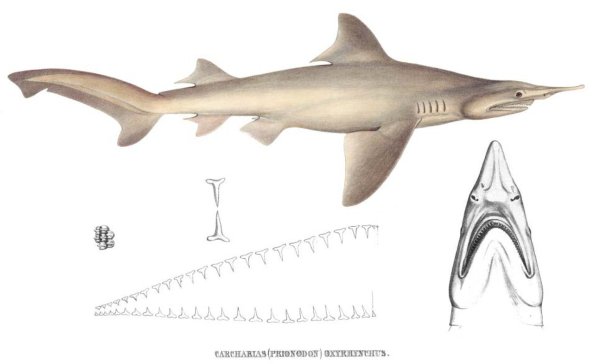
Image of the original description of Isogomphodon oxyrhynchus (MÜLLER & HENLE, 1838)
What does this mean for the future of the species?
The study published last month looked at the status of the daggernose shark population off the coast of Brazil, using historical shark-capture data to assess its current risk for extinction.
The researchers found that during the 1990s most of the daggernose sharks caught and killed in gillnets were juveniles. This statistic has grave implications for the species, as it indicates that over 25 years ago these sharks were already suffering high mortality rates in individuals that weren’t mature enough to have reproduced.
Some action has been taken to protect the species since then. In 2001, the IUCN declared the daggernose critically endangered and the sharks have been legally protected in Brazilian waters since 2006. Unfortunately, the regulations put in place to protect the species have never been enforced and to make matters worse, gillnet usage in many primary daggernose habitats has tripled since the 1990s.

Image Source: https://pbs.twimg.com/media/CoC805qUIAAunPe.jpg; Gillnets are responsible for killing many daggernose shark juveniles
As a result of poor regulation, the daggernose population has plummeted down to a fraction of historic numbers.
In the paper, the researchers call for “urgent and effective conservation measures” to prevent a complete collapse of the species. The IUCN recommends an extension of Brazil’s conservation areas to include more daggernose habitat, in addition to better monitoring of gillnet bycatch and an increase in efforts to study and monitor the species.
Whether these recommendations are translated into action remains to be seen. What is certain is that the daggernose shark has an uphill battle ahead of it. Let’s hope the species can be as tough as its namesake in order to survive.
Read more about the daggernose shark at scientificamerican.com and iucnredlist.org.

