“King of the Jungle” Depends on Survival of Modern Zoos
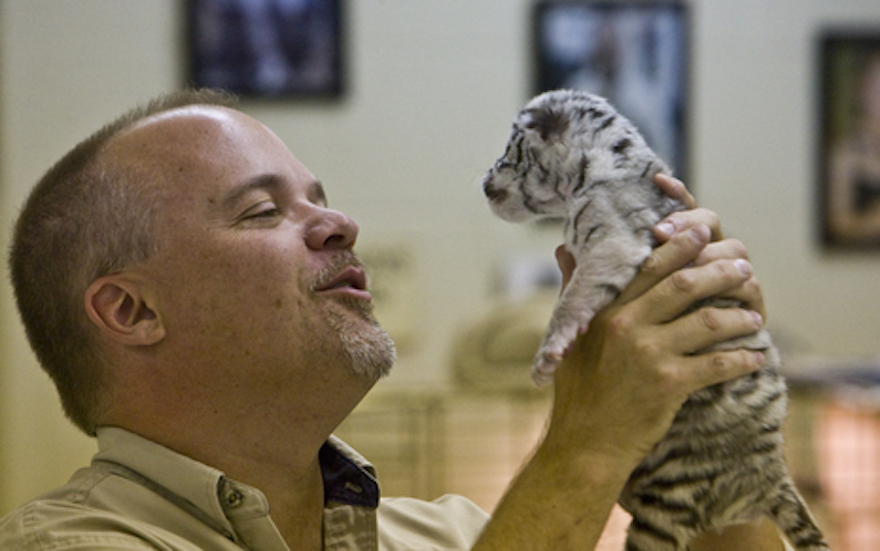
Photo credit: Charlie Leight/The Arizona Republic
The following post is by contributor, Dr. Grey Stafford:
A couple of news events in 2014 involving wild animals in Europe are just the latest examples that suggest 21st century zoos & aquariums are experiencing an identity crisis.
One was marked by widespread media coverage over an international uproar concerning a young giraffe culled, dissected and later fed to the large carnivores on exhibit at a zoo in Denmark. The second was a little reported story about a young orca calf separated from its pod for several days in the waters around Norway.
It ultimately died alone having beached itself in a few inches of water slowly suffocating under its own weight because nobody wanted to intervene, if, paraphrasing one quoted researcher, it would mean a lifetime swimming in tanks.
This quandary couldn’t have come at a worse time for global conservation efforts given the clamor by a small but vocal minority that believe we’ve outgrown zoos like SeaWorld based merely on a film filled with fiction, combined with poorly thought out government wildlife policy shifts, and the unsustainable levels of wildlife poaching pushing species like rhinos and even African lions and elephants to the edge of extinction – not generations from now but within the next decade.
Ponder that thought for just a moment, the “king of the jungle” may actually go extinct in the wild.
To appreciate the dilemma zoos and aquariums face and why it should matter to all of us, we first need to peel away the ancillary and economic roles these community treasures play to see that at their core, modern zoos and aquariums have two basic tasks.
The original (at least over the past 40-50 years) and most obvious is the public display of individual animals to educate, inspire and dare I say, entertain humans enough to care about all wildlife and wild places in a family friendly and fun setting. This responsibility remains critical to species’ and habitat survival and one zoo professionals take seriously because, as others have written, humans will only try to save the things we hold most dear.
It’s damn near impossible to care for something or change our behavior to preserve “it” unless we’ve made a personal connection to whatever it is, either intellectually, emotionally or ideally, both. Zoos and aquariums make those lasting connections possible in tangible ways that a nature video simply cannot.
The second, less obvious purpose which has emerged over the past few decades thanks to a burgeoning human population ravenous for finite natural resources and a dwindling planet is the study and preservation of entire populations of species – those living in human care and those found in the wild, as well as their increasingly fragmented and degraded habitats.
Admittedly, on this second front, zoos and aquariums haven’t made enough progress. The challenges are great and resources are limited. To be sure, there have been a few notable exceptions such as the California Condor, Black-footed Ferret, Scimitar Horned Oryx and Arabian Oryx which have recovered from mere handfuls of remaining individuals.
Still, as plummeting populations of large antelopes, including oryx, living in zoos over the past decade indicates, even these successful conservation efforts (I.e. staving off a species’ extinction) are at best, temporary.
So, this new and rapidly evolving burden for zoos is harder than the first because, if the giraffe episode, or the ongoing debate about orcas affirms anything, it is that humans connect with individual animals, not faraway, unseen groups of unfamiliar creatures. And, even when those connections are made in the present, there’s always a need to renew and reinvigorate with each generation our ongoing commitment to saving species.
It’s hard to bond with, much less change all of human behavior to preserve in perpetuity, a nebulous concept like a faceless population.
As insurmountable as this added responsibility may seem, today’s zoo and aquarium professionals are up to that challenge. However, a deeper problem and the reason we zoo professionals sometimes struggle to define a clear sense of self to friends and foes alike, stems from the fact that these two distinct tasks are rarely in alignment.
In Nature, the needs of the individual and those of the entire population are often at odds. With few exceptions, Nature’s impartial and efficient, some might say cruel, processes favor the strengthening of entire populations at the expense of an individual’s welfare.
Conversely, when we set our minds to it, humans have developed the skills and knowledge to care for all sorts of individual animals, like the California sea lions that washed up onshore in record numbers last year.
Unfortunately, we often fail to muster the collective willpower and economic conditions to preserve entire populations or the habitats needed to support them.
Paradoxically, for zoos and aquariums, each of these fundamental responsibilities is critical to the success of the other! We just haven’t quite worked out how best to accomplish both. But thanks to the animals, dedicated caregivers like those at places such as SeaWorld and other modern zoos, and our public’s support, we are learning with each day, each individual and each population.
And therein lies the future pathway for zoos and aquariums. We, as zoo professionals, must continue to balance the welfare of the individuals in our immediate care with the pressing need to preserve zoo and wild populations in crisis on the land, in the air and under the sea.
We must and can excel at both tasks at the same time, but certain concessions must be made and cooperation will be required of every stakeholder, including zoos and aquariums from differing regions and accrediting associations, the private sector, governments, NGOs and even those adamantly opposed to zoos.
We must convey the need and build greater support for these opposing, but mutually dependent missions to 7 billion, soon to be 9 billion, consumers before many more species are forever lost. And finally, we must and hopefully will determine a way to pay for it without demonizing responsible private enterprise or soaking taxpayers.
Whatever the solutions to these and other perennial challenges stemming from the intersection of civilization, commerce and conservation, one thing is certain: with the Earth increasingly looking like a (mis)managed wildlife reserve, the role of modern zoos and aquariums is more critical to species and habitat survival than ever before.
Grey Stafford is an animal trainer, zoologist, educator, and currently the Director of Conservation at the Wildlife World Zoo and Aquarium in Phoenix, AZ.