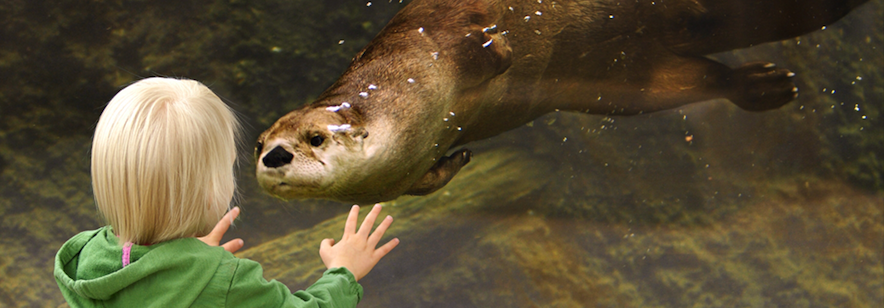
Turn Off The TV and Go To A Zoo
We’ve all heard it or said it: Turn off the television and go outside.
This directive was not just for our health, it was also encouragement to explore the world for ourselves. Go out and experience things first-hand – learn.
But there has been an almost surreal movement of late when it comes to experiencing life in, well, real life. We hear this a lot – zoos and aquariums should be shut down; they don’t do anything to inspire connections between man and animal.
Animal rights extremists claim that there is no value in being able to see an animal up close – a YouTube video would suffice.
The AwesomeOcean team has consistently said that’s crazy talk: here, here, & here.
“Awe, that cute pixelated dolphin inspires me to save marine life!” said NO ONE EVER.
Interestingly enough, the opinion held by most people – that zoos and aquariums ARE important and DO play a vital role in conservation – is actually true … and this time it’s peer-reviewed.
A recently released study in the Journal of the International Society for Anthrozoology – Athrozoos – demonstrates the value of zoos and aquariums to encourage people to be more pro-environment and engage in conservation efforts.
Evaluation of Factors Affecting Emotional Responses in Zoo Visitors and the Impact of Emotion on Conservation Mindedness found visitors who experience positive emotions during a zoo, natural history museum or wildlife tourism experience report greater concern or respect for nature and indicate a willingness to participate in conservation.
Dr. David Powell from the Wildlife Conservation Society and Elizabeth V.W. Bullock from the University of Edinburgh’s Psychology Department conducted surveys of zoo-goers and an extensive review of psychology literature.
They write:
A growing body of literature suggests that emotional stimulation is affected by characteristics of both the visitor and the visitor’s experiences and is important for learning and inspiring pro-environmental sentiment.”
Powell and Bullock conducted surveys of visitors to various exhibits at the Wildlife Conservation Society’s Bronx Zoo.
The surveys showed positive emotional response depended on the visitor’s prior knowledge of the animal and the animal’s activity level. For example, people didn’t have much of a reaction to the zoo’s African wild dog exhibit – not much knowledge about the wild dogs and they didn’t move around much. On the other hand, visitors had a strong emotional response to the tiger exhibit – familiar and active animals.
The research also found that visitors who already had a strong pro-environmental opinion had their commitment to conservation strengthened by the positive emotional experience.
Powell and Bullock concluded:
Strong, positive emotional experiences of zoo visitors interact with their pre-existing knowledge of and affinity for nature to provide inspiration for them to become engaged in conservation and possibly facilitate learning in an informal setting. The magnitude of the emotional response is in part due to characteristics of the visitor (e.g., gender) and the animals they see (e.g., species, activity level).”
In his February 13, 2015 column on shutting down zoos in Outdoor Magazine, Tim Zimmerman writes:
There was a time when zoos really were the only place to see exotic animals. Today you can experience our greatest creatures in other ways—on YouTube or PBS, for starters, in full HD.”
Mr. Zimmerman would rather us sit in front of a screen and watch a video of animals – hardly a way to have a real, positive and emotional experience and hardly a way to strengthen people’s commitment to conserving animal populations.
So turn off the television and go to a zoo or aquarium. Have a great time and take your experience home with you. The animals and the environment will thank you.