A Young Humpback Was Dragging 100 Feet of Line Off San Clemente. A SeaWorld-Led Team Cut It Free.
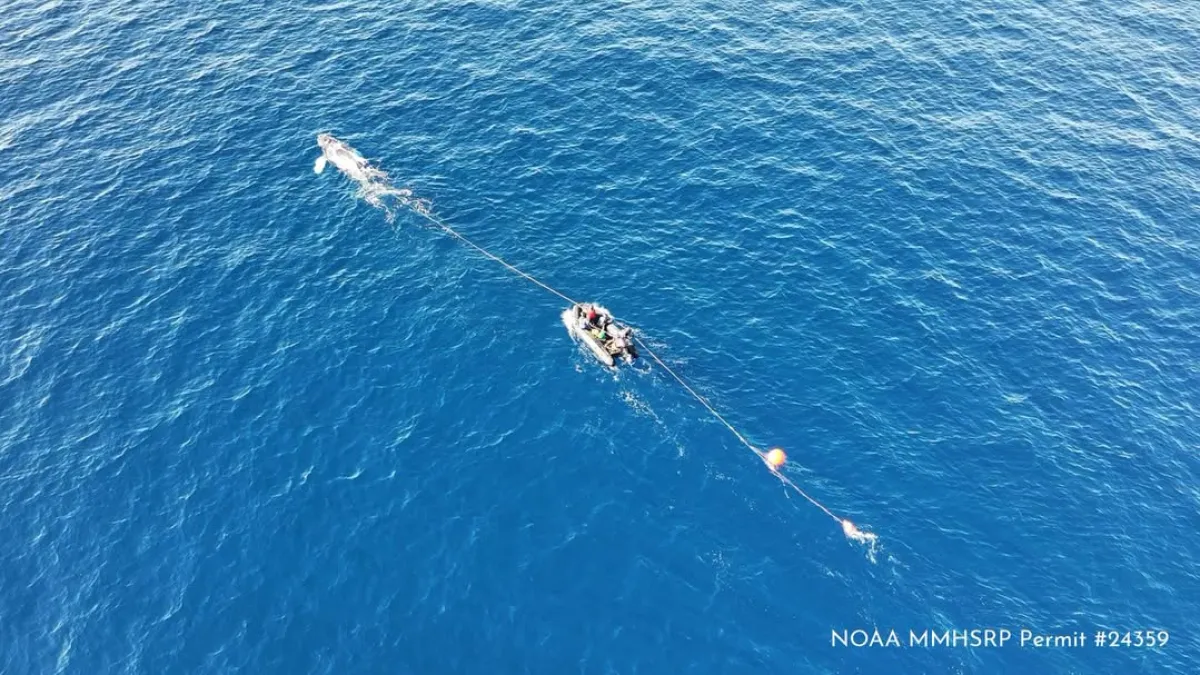
A fisherman spotted the whale around 9:30 a.m. about five miles off San Clemente. It was a young humpback, roughly 29 feet long, trailing about 100 feet of fishing line. Drone and underwater footage later showed the line wrapped in several layers across the whale’s underside, its tail flukes and its peduncle, the thick, muscular section just before the tail.
Responders from three organizations went out after it: SeaWorld San Diego, the Laguna Beach-based Pacific Marine Mammal Center and Entangled Whale Response Orange County. All three are partners in NOAA Fisheries’ West Coast stranding network, which authorizes trained teams to approach and work on entangled whales.
Cutting a Whale Free
Disentangling a whale is slow, dangerous work. Responders can’t restrain a 29-foot animal, so they have to read the entanglement from a distance and make each cut count. The team used drones and underwater cameras to map how the line was wrapped before moving in.
Just before 3:30 p.m., they cut sections of the twisted line. Over several deep dives, the whale shook loose most of what was left. By late afternoon, when crews tracked it near the San Clemente Pier, it had shed nearly all of the 100 feet.
Underwater video reviewed the next day confirmed the rescue worked. The whale has a scar on its peduncle but otherwise appears healthy. According to the Pacific Marine Mammal Center, it was the first successful disentanglement off the Southern California coast this year.
“In most cases an entanglement such as this can eventually lead to death,” said Keith Yip, a NOAA Level 4 responder with SeaWorld San Diego. “Disentangling this whale gave it a second chance.”
A Bad Year for Entanglements
Whales caught in line and gear can struggle to swim, feed and breathe, and many entanglements end in a slow death. They are becoming more common. There have been 46 confirmed whale entanglements on the West Coast so far in 2026. Before 2014, fewer than 10 humpback entanglements were reported there in a typical year.
NOAA scientists say this year’s spike may be tied to the extreme El Niño, which can push whales and the fish they eat closer to shore, where fishing gear is concentrated. The Pacific Marine Mammal Center considers it likely that the West Coast will see more entanglements this year than during the 2015-16 El Niño. That event set records.
Not every case ends like this one. Off Oregon this summer, responders freed a young humpback from more than 3,000 feet of line, five sablefish pots and several Dungeness crab traps, but the gear had left its jaw permanently open, and it is not expected to survive. Off Southern California, initial attempts to cut gear from a gray whale calf traveling with its mother were unsuccessful.
How to Help
Most rescues begin with a report from someone on the water. Anyone who sees an entangled whale should keep their distance, stay with the animal if it’s safe, and call NOAA’s Entanglement Reporting Hotline at 1-877-SOS-WHAL (1-877-767-9425) or hail the U.S. Coast Guard on VHF Channel 16. Untrained people should never try to cut a whale free. It’s dangerous for the rescuer and can leave the worst of the gear in place.
Sources: Pacific Marine Mammal Center, FOX 5 San Diego, Hoodline, NOAA Fisheries.