Humpback Entanglements on the West Coast Are the Highest in a Decade. The Fix May Be Sitting on the Ocean Floor.
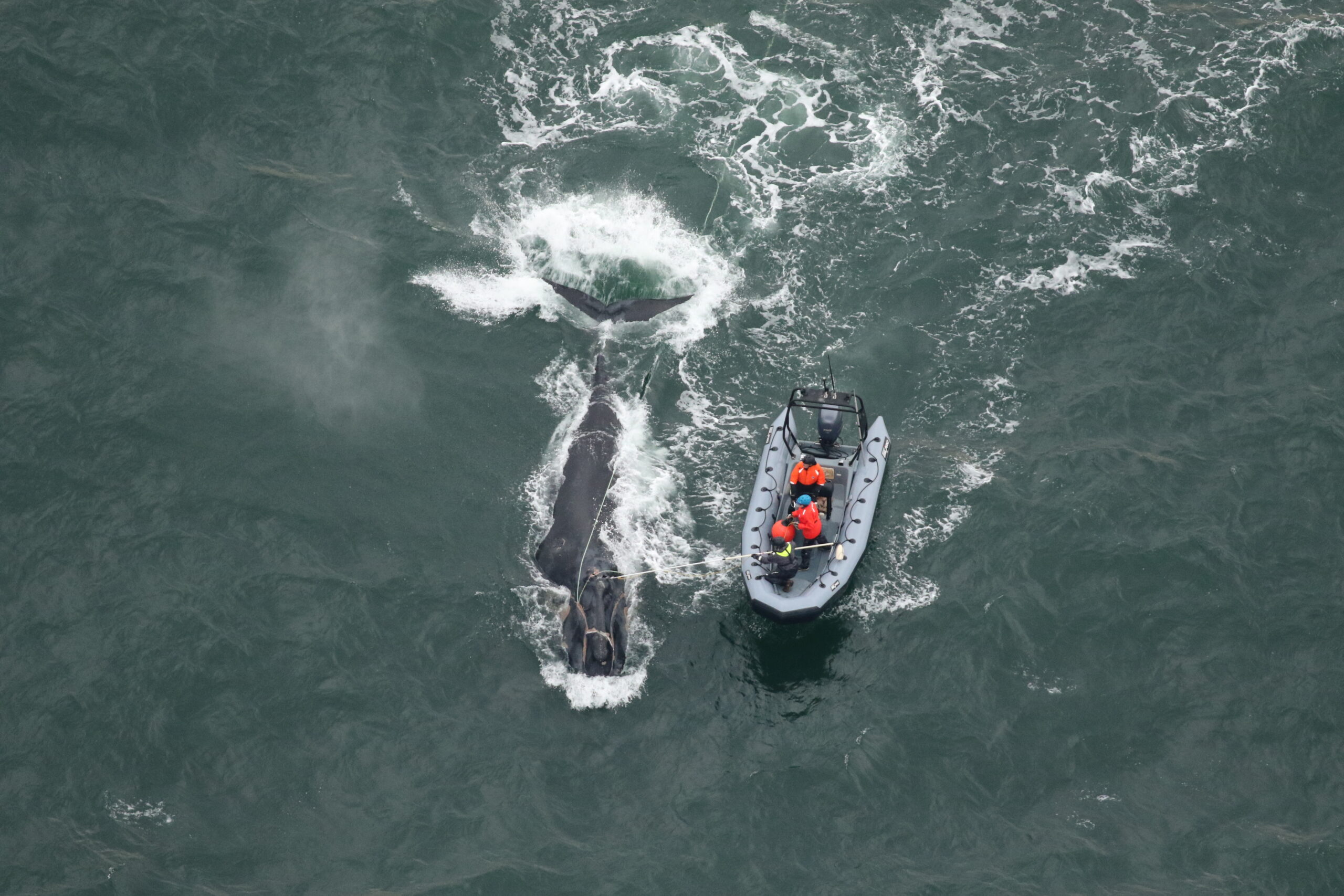
When a report comes in about a whale dragging fishing line off the coast of Washington, there is one team in the Pacific Northwest the federal government authorizes to lead the rescue. It is five people from Cascadia Research Collective, a small nonprofit in Olympia. They work from small research boats, never in the water, using long poles fitted with hook knives to cut rope off an animal that may weigh 30 tons and has no idea anyone is trying to help.
“The whales never know that we’re helping,” said Jenn Tackaberry, co-director of the group’s entanglement response team. “If you think about it, the whales are having one of the worst days of their life.”
This year has brought a lot of those days. Through early October, at least 37 humpback whales had been reported entangled off the U.S. West Coast in 2026, according to preliminary federal figures cited by the Center for Biological Diversity. That is the most since 2016, with nearly three months still left in the year.
The surge is putting pressure on rescuers, regulators and the fishing industry at the same time. It is also sharpening a long-running argument over a deceptively simple question: can fishermen keep catching crab without leaving miles of rope hanging in the water where whales feed?
What the numbers show
NOAA Fisheries’ annual national report, released Sept. 30, confirmed 76 large whale entanglements in U.S. waters in 2025. That was down from 95 the year before, but slightly above the 18-year average of about 73.
Humpbacks dominated the list, with 65 of the 76 cases. The rest were four gray whales, two fin whales, and one each of minke, sperm and North Atlantic right whale. Seventy of the cases involved whales that were still alive when they were reported.
The Pacific accounted for 78% of confirmed entanglements. Four states, California, Alaska, Hawaii and Washington, made up nearly 80% of the total. Washington had nine. Of those, responders fully freed two whales and partially freed a third. Four whales, including a killer whale, broke loose on their own. One gray whale died, and one entangled whale could not be reached.
The national figures likely understate the problem. Only about 46% of last year’s cases could be traced to a specific type of fishing gear. And federal scientists have estimated that some West Coast fisheries may be responsible for as many as five times more entanglements than are actually reported, because most entangled whales are never seen by anyone.
Why it’s happening now
Researchers and federal officials point to the ocean itself. Humpbacks off the West Coast feed in a band of cool, nutrient-rich water close to shore. During marine heat waves, warm offshore water presses toward the coast and squeezes that band. Anchovies and other prey crowd into a narrower strip, and the whales follow them, into the same nearshore waters where crabbers set their traps.
Michael Milstein, a NOAA spokesperson, described that chain of events: heat waves shift the cold water, the anchovies move with it, and the whales move with the anchovies. Tackaberry said responders are seeing more reports than usual this year, a pattern that has historically lined up with El Niño conditions.
The West Coast has seen this before. Entanglements spiked during the 2014 to 2016 marine heat wave known as “the Blob” and have stayed elevated ever since.
Where the rope comes from
A traditional crab or fish trap sits on the seafloor, connected by a vertical line to a buoy at the surface so the crew can find it and haul it up. Multiply that by tens of thousands of traps and you get a forest of rope running from the bottom to the surface, often right where whales are feeding.
In 2025, seven humpbacks off the West Coast were caught in gear from the commercial Dungeness crab fishery, according to the Center for Biological Diversity. Two more were caught in California’s coonstripe shrimp fishery, which has fewer than 20 boats. The West Coast sablefish pot fishery has entangled three whales so far this year.
New federal rules, and their critics
On Oct. 9, the National Marine Fisheries Service published new rules for the sablefish pot fishery. They require stricter markings on fishing line, so investigators can identify the source of gear found on an entangled whale. They also limit how much line can float near the surface, and they allow fishermen to use a single vertical line instead of two. The measures came from a West Coast Take Reduction Team, a group of fishermen, scientists and conservationists that recommended them in April.
Conservation groups say the rules will help identify the problem without doing enough to prevent it. “These new rules will help figure out what kind of gear is causing deadly entanglements,” said Ben Grundy-Hawley, an oceans campaigner at the Center for Biological Diversity. “The agency needs to enact much stronger protections for this fishery.”
A trap with no rope
The alternative getting the most attention is called pop-up, ropeless or “on-demand” gear. The traps still sit on the seafloor, but the buoy and its line stay coiled at the bottom with them. When the crew returns, a signal sent from the boat triggers a release, and the buoy floats to the surface so the traps can be hauled up. Between hauls, there is no rope in the water column for a whale to swim into.
California has spent three years testing whether that works at commercial scale. In spring 2024, 19 boats fished more than 23,000 ropeless traps under an experimental permit and landed about 229,000 pounds of Dungeness crab worth an estimated $1.6 million. In spring 2025, crabbers deployed and retrieved gear more than 1,100 times with better than 98% reliability, landing about 217,000 pounds worth an estimated $1.4 million.
In February, the California Department of Fish and Wildlife for the first time approved ropeless traps as an alternative for the commercial Dungeness crab fishery. That lets crabbers who use the gear keep fishing during the spring, when the state often closes or restricts traditional gear to protect migrating whales.
“The authorization of pop-up gear is a huge step in stabilizing what has been a very shaky fishery over the past decade,” said Brand Little, a commercial crab fisherman.
The case for caution
Not everyone in the industry is convinced. The equipment from Sub Sea Sonics, the first manufacturer approved, costs about $1,200 per string of traps, or roughly $60 per trap on a 20-trap string, plus about $2,000 for the deck box and transducer that trigger the release. Grants and discounts from a private donor, the Euphotic Foundation and low-interest loans from California FarmLink are helping offset the cost, but only for a limited number of boats.
That cost lands on a fleet that is already struggling. California crabbers have faced delayed openings and limits on how many traps they can fish, and the state’s king salmon season has been closed. When the 2024 trial let 19 boats keep fishing during a spring closure, many crabbers who were left out were angry about it, according to National Fisherman. Others raised concerns about reliability, the learning curve, and what happens when the release fails. During the trial, crews sometimes had to recover stuck traps with grappling hooks.
Supporters, including the conservation group Oceana, argue the trials show the gear can be profitable and whale-safe at the same time. Ahead of this year’s spring season, its California campaign director, Geoff Shester, said “all eyes are on” the fishery to see how the gear performs.
The people in the boats
Whatever happens with gear, the whales already entangled still need someone to cut them free, and that system is under strain. Cascadia Research Collective’s 2026 response volume has already used up its budget for the year, Tackaberry said. A federal grant was canceled in 2025, and the group faces a federal funding gap starting in January.
“2027 is shaping up to be a tough year,” she said.
Responders say the most useful thing the public can do is report entangled whales quickly and stay back. Approaching an entangled whale is dangerous, and only trained, authorized teams should try to remove gear. NOAA’s regional hotlines are (877) SOS-WHALE (767-9425) for California, Oregon and Washington; (877) 925-7773 for Alaska; (888) 256-9840 for Hawaii; (866) 755-6622 from Maine to Virginia; and (877) WHALE-HELP (942-5343) from North Carolina to Texas.
The whales will never know who helped them. But how many need help in the first place may depend on what is, or isn’t, hanging in the water.
Sources: NOAA Fisheries; Washington State Standard via The Columbian; SeafoodSource; Center for Biological Diversity; Monterey County Weekly; National Fisherman